

Abstract: Executive and organizational coaching literature has long positioned questioning as a facilitative communication skill — a conversational tool for stimulating reflection and behavioral change. This instrumental framing, however, leaves inquiry theoretically underdeveloped and obscures its constitutive role in reshaping leadership cognition and organizational sensemaking. This article presents the Cognitive–Action Inquiry Matrix (CAIM), a conceptual framework that reconceptualizes structured inquiry as an epistemic intervention: a mechanism through which coaches systematically disrupt maladaptive cognitive schemas, surface governing assumptions, and enable systemic reframing. Drawing on dual-process cognition, double-loop learning, reflective practice, and predictive processing, CAIM organizes four inquiry architectures — LEGAL, LBAC, L-COACH, and LCMM — across two dimensions: cognitive depth and action orientation. The framework advances five falsifiable theoretical propositions and operationalizes cognitive entropy — the persistence of conflicting or unresolved interpretive schemas in leadership cognition — as the central mechanism linking inquiry design to organizational learning outcomes. Boundary conditions governing framework applicability and a structured empirical research agenda are specified to guide future validation. Keywords: coaching inquiry · epistemic intervention · cognitive entropy · Cognitive–Action Inquiry Matrix · double-loop learning · leadership cognition · sensemaking · inquiry architecture 1. Introduction 1.1 The Problem of Under-Theorized Inquiry Executive coaching has accumulated a substantial body of empirical support for questioning as a driver of reflection, behavioral change, and leadership development. Yet across this literature, a persistent theoretical asymmetry remains: while the outcomes of effective questioning are increasingly well documented, the mechanisms through which structured inquiry produces cognitive and organizational transformation remain largely unspecified. The dominant framing treats questions as facilitative instruments — conversational moves that “unlock” client insight, stimulate self-reflection, or challenge limiting beliefs. This framing is not incorrect, but it is incomplete. It positions inquiry as a technique applied to a pre-existing cognitive architecture, rather than as a force that constitutes and reorganizes that architecture in real time. The critical question is not merely what to ask, but how sequences of inquiry are architecturally designed to produce cognitive and organizational transformation. 1.2 Inquiry as Epistemic Intervention This article advances a different theoretical premise: coaching inquiry is an epistemic intervention. When a coach deploys a structured sequence of questions, they are not merely extracting information from a client’s existing mental model — they are actively altering the cognitive schemas through which the client perceives, interprets, and acts upon their organizational reality. This reframing draws on three converging theoretical traditions: • Dual-process cognition (Kahneman, 2011; Evans & Stanovich, 2013): inquiry can selectively engage or bypass System 1 heuristics, forcing deliberative System 2 reappraisal of governing assumptions. • Double-loop learning (Argyris & Schön, 1978): transformative inquiry does not simply solve problems within existing frames — it surfaces and restructures the frames themselves. • Sensemaking theory (Weick, 1995): questions shape what leaders notice, how they bracket ambiguity, and what action repertoires they perceive as available. Structured inquiry reorganizes perception before it reorganizes behavior. Together, these traditions suggest that inquiry effectiveness is not primarily a function of question content, but of inquiry architecture — the deliberate sequencing, framing, and depth calibration of questioning across a coaching engagement. 1.3 The Problem of Cognitive Entropy A second theoretical gap motivates this article. Existing coaching models offer limited specification of when inquiry produces generative learning versus when it produces cognitive destabilization or defensive resistance. We introduce cognitive entropy as an explanatory mechanism: the persistent state of conflicting or unresolved interpretive schemas in a leader’s cognition. Elevated cognitive entropy — characteristic of leaders navigating organizational ambiguity, role transition, or strategic uncertainty — creates the conditions under which structured inquiry can either catalyze transformative reframing or, if misaligned with developmental readiness, amplify disorientation and shutdown. Effective inquiry architecture must therefore be calibrated to the client’s entropic state. This calibration problem is one CAIM is designed to address. 1.4 The Cognitive–Action Inquiry Matrix (CAIM) This article introduces the Cognitive–Action Inquiry Matrix (CAIM) as a conceptual framework for classifying, sequencing, and deploying inquiry architectures in executive and organizational coaching. CAIM organizes inquiry along two theoretically grounded dimensions: 1. Cognitive Depth — the degree to which inquiry challenges, reconstructs, and reintegrates governing assumptions and mental models. 2. Action Orientation — the degree to which inquiry drives experimentation, behavioral commitment, and organizational implementation. The intersection of these dimensions generates four distinct inquiry architectures:
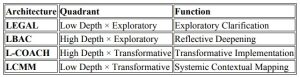
Each architecture is not an isolated technique but a structured system of inquiry — with defined sequencing logic, epistemic targets, and applicable boundary conditions. 1.5 Theoretical Contributions and Article Structure This article makes three principal theoretical contributions: 1. Reframes coaching inquiry as epistemic intervention, connecting question architecture to the cognitive and sensemaking mechanisms through which leadership transformation occurs. 2. Introduces CAIM as a two-dimensional matrix providing a common theoretical language for locating, comparing, and sequencing diverse inquiry approaches within a unified conceptual structure. 3. Advances five falsifiable theoretical propositions, specifying applicable boundary conditions and proposing a structured empirical research agenda to guide systematic validation of the framework. The article proceeds as follows: Section 2 reviews the theoretical foundations of CAIM. Section 3 elaborates the framework’s two dimensions. Section 4 specifies the four inquiry architectures and their empirical propositions. Section 5 discusses boundary conditions, limitations, and the research agenda. Section 6 concludes. 2. Theoretical Foundations The CAIM framework is grounded in four converging theoretical traditions: dual-process cognition, double-loop learning, reflective practice, and organizational sensemaking. Each tradition contributes a distinct mechanism by which structured inquiry produces epistemic change. 2.1 Dual-Process Cognition and the Architecture of Reflective Interruption Dual-process theory distinguishes between fast, automatic cognition (System 1) and slow, deliberate cognition (System 2) (Kahneman, 2011). In complex organizational environments, leaders disproportionately rely on System 1 heuristics — efficient but vulnerable to entrenched bias and unexamined assumption. Coaching inquiry can function as a cognitive interruption mechanism: it decelerates automatic processing and creates the conditions under which System 2 evaluation becomes accessible. Critically, this interruption is not a passive by-product of asking questions; it is an architecturally intentional effect of how inquiry sequences are designed. This argument converges with predictive processing accounts of cognition (Clark, 2016; Friston, 2010). The brain continuously generates predictive models of the environment and updates them when prediction errors arise. Structured inquiry systematically generates such prediction errors — introducing perspectives that the client’s current model cannot accommodate — thereby triggering deep model revision rather than surface behavioral adjustment. The result is a three-stage mechanism: 1. Disruption — a well-formed inquiry question renders the client’s habitual interpretive frame temporarily inoperative. 2. Dissonance — the resulting gap between existing model and new information produces productive cognitive tension (cf. Argyris, 1977). 3. Reconstruction — sustained inquiry supports the construction of a revised interpretive framework with greater explanatory adequacy. This three-stage sequence constitutes the core mechanism by which inquiry reduces cognitive entropy — defined here as the persistent state of interpretive disorder in which a leader’s existing mental models are insufficient to organize experience into actionable understanding. Unlike its thermodynamic origin, cognitive entropy is used here as a formal theoretical construct describing the degree of unresolved schema conflict in a leader’s sensemaking system (cf. Weick, 1995, on equivocality reduction). 2.2 Double-Loop Learning and Governing Variables Argyris’ (1977; 1991) theory of double-loop learning provides the normative target of coaching inquiry. Single-loop learning corrects behavior within existing assumptions; double-loop learning surfaces and revises the governing variables — the values, beliefs, and interpretive commitments — that generate those behaviors. Double-loop learning does not emerge spontaneously. It requires deliberate inquiry sequences that make governing variables visible and cognitively accessible. The CAIM framework is designed specifically to create these conditions: its higher-order architectures (L-COACH, LCMM) correspond to inquiry patterns that operate at the governing-variable level rather than the behavioral-correction level. 2.3 Reflective Practice and the Articulation of Tacit Knowledge Schön’s (1983) concept of reflective practice builds on Polanyi’s (1966) foundational insight that professional expertise is substantially tacit — encoded in practice but not accessible to explicit verbal report. Leaders routinely act from implicit mental models whose assumptions remain invisible precisely because they are effective. Inquiry enables the articulation of tacit frameworks. Through reflective dialogue, leaders are supported to observe their own thinking processes — not merely to reflect on outcomes, but to examine the interpretive logic that generated those outcomes. This is Schön’s distinction between reflection-on-action and reflection-in-action, both of which are addressable through intentionally sequenced coaching inquiry. 2.4 Organizational Sensemaking Weick’s (1995) sensemaking framework holds that organizational actors do not discover reality; they enact it through interpretive processes of selection, retention, and retrospective meaningconstruction. Leaders are not merely participants in organizational sensemaking — they are its primary architects, shaping the narratives through which collective understanding is organized. This has a direct implication for coaching: inquiry that changes how a leader interprets ambiguous organizational events does not merely support individual reflection — it intervenes in collective sensemaking processes. The coach who architects inquiry therefore functions, in Weick’s terms, as a second-order sensemaker: shaping the conditions under which organizational meaning itself is constructed. This positions coaching inquiry as an organizational intervention, not merely an individual developmental tool — a claim that the CAIM framework operationalizes in Section 4. 3. Inquiry as Epistemic Architecture Building on the theoretical foundations established above, this paper proposes a conceptual reorientation: coaching inquiry should be understood not as a collection of conversational techniques but as an epistemic architecture — a designed system for organizing the conditions under which interpretive change becomes possible. An inquiry architecture is defined here as a structured pattern of questioning that operates along two regulative dimensions: • Cognitive depth: the degree to which inquiry challenges and requires revision of a leader’s existing interpretive assumptions, from surface-level clarification to governingvariable examination (cf. Argyris, 1991). • Action orientation: the degree to which inquiry sequences are directed toward behavioral experimentation and organizational commitment, rather than remaining within the space of reflection alone. The intersection of these two dimensions generates qualitatively distinct types of inquiry — architectures that differ not in technique but in their epistemic function: what they require of the leader’s cognition, and what kind of change they make possible. This is the generative logic of the CAIM framework, developed in Section 4. 3.1 Cognitive Entropy as the Target of Epistemic Intervention Within this framework, the primary object of coaching inquiry is cognitive entropy — defined as the persistent state of unresolved schema conflict in which a leader’s existing mental models are structurally insufficient to organize experience into actionable understanding. The term is borrowed from information theory as a theoretical construct, not as a quantitative measure: it describes the degree of interpretive disorder within a leader’s sensemaking system (cf. Weick, 1995). High cognitive entropy is operationally recognizable in three patterns: • fragmented or inconsistent strategic interpretations • oscillating or reactive decision-making under ambiguity • inability to integrate new information with existing frameworks without significant cognitive cost Epistemic architecture reduces cognitive entropy through a three-stage sequence derived from the theoretical framework in Section 2: disruption of the existing interpretive frame, dissonance that renders the inadequacy of that frame salient, and reconstruction through progressively coherent re-engagement with experience. Critically, this sequence does not occur automatically — it is an architectural achievement, dependent on the deliberate sequencing and depthcalibration of inquiry. 3.2 The Coach as Second-Order Sensemaker The reframing of inquiry as epistemic architecture carries a parallel implication for the role of the coach. Within the sensemaking tradition (Weick, 1995), organizational actors construct meaning through iterative cycles of interpretation and enactment. Leaders are not passive processors of organizational reality — they are its primary architects, shaping the narratives through which collective understanding is organized and sustained. The coach, within this framework, operates at a second order: rather than participating directly in organizational sensemaking, the coach shapes the conditions under which the leader’s own sensemaking processes are examined, disrupted, and revised. This is what distinguishes coaching inquiry from advisory input or managerial feedback. Where advice introduces new content into the leader’s interpretive system, inquiry intervenes in the structure of that system — in the assumptions, framings, and governing variables through which content is processed. This second-order function is not incidental to coaching effectiveness; it is its mechanism. The empirical literature consistently finds that coaching outcomes correlate less with the specific content of coaching conversations than with the depth of reflective engagement those conversations produce (cf. de Haan et al., 2013; Ely et al., 2010). Epistemic architecture is the designed attempt to make depth of reflective engagement a reliable, reproducible outcome rather than an occasional by-product of conversational chemistry. 3.3 From Technique to Architecture: A Definitional Distinction The distinction between technique and architecture merits explicit statement, as it is fundamental to the theoretical contribution of this paper. A technique is a discrete conversational act — a question type, a reframing move, a silence — whose effect is local and largely independent of its position in a sequence. Technique-based accounts of coaching inquiry (e.g., Whitmore, 2009; Stoltzfus, 2008) provide valuable practitioner guidance but remain theoretically underspecified: they describe what coaches do without providing a principled account of why particular patterns of questioning produce durable cognitive change. An architecture, by contrast, is a designed sequence whose properties are systemic rather than additive. The epistemic effect of an inquiry architecture is not the sum of its constituent questions — it is a property of the pattern: the way in which questions are ordered, calibrated in depth, and oriented toward cognitive or behavioral outcomes. This systemic property is what makes architecture amenable to theoretical specification and empirical investigation in a way that technique-cataloguing is not. The CAIM framework operationalizes this distinction by providing a structural classification of inquiry patterns according to their position on the two regulative dimensions — cognitive depth and action orientation — rather than according to their surface form or topical content. Four architecturally distinct inquiry patterns are identified, each with a characteristic epistemic function, a corresponding theoretical grounding, and a defined domain of coaching application. These are developed in detail in Section 4. 4. The Cognitive–Action Inquiry Matrix (CAIM) 4.1 Rationale and Structural Logic Existing typologies of coaching inquiry have largely proceeded by cataloguing questioning techniques without providing a unifying structural logic that specifies why a given inquiry architecture is appropriate at a given moment in the coaching process (Stober & Grant, 2006; Bachkirova, 2011). The Cognitive–Action Inquiry Matrix (CAIM) addresses this gap by positioning four inquiry architectures within a two-dimensional coordinate system defined by their epistemic function rather than their surface form. The matrix is a classification framework, not a hierarchy. No quadrant is inherently superior; each occupies a distinct functional niche determined by where the leader sits developmentally and what the coaching episode demands. 4.2 The Two Axes Axis 1 — Cognitive Depth refers to the degree to which an inquiry architecture challenges, surfaces, and reconstructs a leader’s operative assumptions. At the low end, questions clarify, name, and organize existing constructs. At the high end, questions induce metacognitive disruption — temporarily destabilizing a leader’s interpretive frame so that new epistemic structures can form (Mezirow, 1991; Kegan & Lahey, 2009). Axis 2 — Action Orientation refers to the degree to which the inquiry is directed toward behavioral experimentation, implementation, and organizational commitment. At the exploratory pole, inquiry is generative and non-directive, optimized for meaning-making. At the transformative pole, inquiry is converging toward concrete accountability structures and systemic behavioral change. These two axes produce a 2×2 matrix with four quadrants, each hosting one of the four inquiry architectures examined in this paper. 4.3 Quadrant Mapping

4.4 The Four Inquiry Architectures 4.4.1 LEGAL — Exploratory Clarification (Low Cognitive Depth × Exploratory Orientation) The LEGAL model occupies the entry quadrant of the CAIM. Its function is not to challenge assumptions but to establish the shared interpretive foundation without which deeper inquiry cannot proceed safely. Drawing on Edmondson’s (1999) work on psychological safety, LEGAL questioning creates the conditions under which a leader can acknowledge uncertainty without threat to professional identity. Questions in this quadrant are characteristically open, temporally proximate, and semantically grounded — they ask what is happening before asking why it is constructed this way. Falsifiability note: If LEGAL-type questioning is applied to leaders already operating at high reflective maturity (Kegan Stage 4–5), the model predicts no significant shift in self-reported psychological safety , because the prerequisite safety is already present. Sustained LEGAL inquiry with such leaders would constitute a misallocation of coaching time. 4.4.2 LBAC — Reflective Deepening (High Cognitive Depth × Exploratory Orientation) The LBAC model — structured around Learning & Mapping, Belief Deconstruction, Assessment & Scenario-Based reasoning, and Choice Architecture — occupies the high-depth exploratory quadrant. Its defining function is metacognitive disruption: the deliberate surfacing and examination of the mental models that govern a leader’s interpretive responses (Argyris & Schön, 1978). This architecture is the primary vehicle for double-loop learning within the CAIM system. The exploratory orientation means that LBAC inquiry remains generative; it opens interpretive space rather than closing it toward a predetermined action. Falsifiability note: If LEGAL-type questioning is substituted for LBAC in contexts requiring assumption restructuring, the model predicts no significant reduction in cognitive rigidity as measured by post-session construct repertoire breadth . Surface-level clarification cannot achieve the epistemic work required in this quadrant. 4.4.3 L-COACH — Transformative Implementation (High Cognitive Depth × Transformative Orientation) The L-COACH model occupies the most epistemically demanding quadrant — one that combines deep assumption-challenging inquiry with a strong convergence toward systemic behavioral implementation. The distinctive mechanism here is epistemic friction: the coach deploys high-depth questions precisely at the moment of action-planning, preventing the collapse of genuine insight into habitual behavioral scripts. L-COACH inquiry does not merely surface new understanding; it insists that new understanding be operationalized within the leader’s actual organizational system (Lawrence, 2015). Falsifiability note: If L-COACH protocols are applied to leaders who have not yet completed LBAC-level assumption work, the model predicts premature behavioral commitment that fails to generalize , because the action architecture is being built on unreconstructed premises. 4.4.4 LCMM — Systemic Contextual Mapping (Low Cognitive Depth × Transformative Orientation) The Leadership Coaching Maturity Matrix occupies a structurally distinct position within CAIM. Unlike LEGAL, LBAC, and L-COACH — which are inquiry sequences that the coach enacts — LCMM is a developmental calibration instrument that the coach employs before and between sessions to determine which inquiry architecture is epistemically appropriate for a given leader at a given moment. LCMM does not directly generate epistemic intervention. Instead, it maps the leader’s current developmental stage across key dimensions — reflective capacity, identity stability, organizational role demands, and coaching relationship maturity — enabling the coach to select and sequence the other three architectures with developmental precision. This positions LCMM as a meta-level navigation tool within the CAIM framework. A leader at an early maturity stage may require sustained LEGAL engagement before LBAC work becomes productive. A leader with high reflective capacity may transition directly into L-COACH. LCMM may equally indicate that a developmental setback warrants temporary regression to a prior architecture. The matrix is a navigation system, not a conveyor belt.
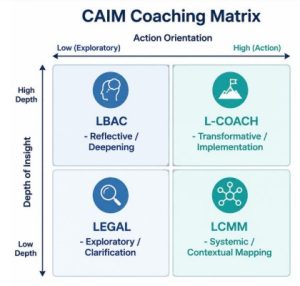
Figure 1. The Cognitive–Action Inquiry Matrix (CAIM): positioning of four inquiry architectures across dimensions of Cognitive Depth (low–high) and Action Orientation (exploratory–transformative). 4.5 Sequencing Logic The CAIM does not prescribe a fixed linear sequence, but the developmental logic of the matrix generates a default trajectory: LEGAL → LBAC → L-COACH, calibrated at each transition by LCMM assessment. This trajectory reflects a movement from psychological safety (foundation) through metacognitive disruption (reconstruction) to transformative implementation (transfer). Deviations from this trajectory are not failures; they are data — and LCMM provides the interpretive frame for reading them. 5. Theoretical Propositions The CAIM framework generates a set of falsifiable theoretical propositions regarding the relationship between inquiry architecture, cognitive transformation, and organizational sensemaking. These propositions are intended to anchor the conceptual framework within an empirically testable theoretical program. Proposition 1 Inquiry processes that increase cognitive depth without corresponding action orientation generate enhanced reflective awareness but produce limited behavioral transformation. Theoretical rationale: Reflection without structured action commitment leaves cognitive dissonance unresolved at the behavioral level. Double-loop learning requires not only the surfacing of governing variables but their systematic revision through enacted experience (Argyris, 1991). Heightened awareness unaccompanied by behavioral consolidation risks cognitive entropy amplification rather than resolution. Falsifiability note: This proposition predicts that coaching interventions classified exclusively within high-depth/low-action quadrants (e.g., LBAC) should produce measurable gains in selfreported reflective awareness while yielding non-significant improvements in 360-degree behavioral assessments at three-month follow-up. Proposition 2 Inquiry processes that emphasize action orientation without adequate cognitive depth produce behavioral compliance rather than epistemic change. Theoretical rationale: Action commitments anchored in unexamined assumptions reproduce existing mental models under new behavioral forms. Without deep model revision, behavioral change remains fragile, context-dependent, and susceptible to regression under conditions of increased organizational complexity or role transition (Kegan & Lahey, 2009). Falsifiability note: This proposition predicts that leaders whose coaching interventions are classified within low-depth/high-action quadrants (e.g., LCMM) without prior or concurrent epistemic disruption will demonstrate significantly higher rates of behavioral regression at sixmonth follow-up relative to leaders exposed to integrated CAIM cycling. Proposition 3 Sustained reductions in leadership cognitive entropy occur when coaching interventions cycle dynamically across all four CAIM architectures rather than remaining fixed within a single quadrant. Theoretical rationale: The disruption–dissonance–reconstruction mechanism described in Section 2.1 requires iterative movement between reflective exploration and action-oriented consolidation. Static deployment of a single inquiry architecture produces plateau effects in both cognitive and behavioral domains, as the generative tension between dissonance and reconstruction is never fully engaged (Mezirow, 1991). Falsifiability note: This proposition predicts that leaders exposed to multi-architecture coaching sequences will demonstrate greater pre-to-post reductions on validated cognitive entropy proxies (e.g., tolerance of ambiguity scales, epistemic flexibility measures) compared to those receiving single-architecture interventions, with effect sizes detectable at d≥0.4d \geq 0.4d≥0.4. Proposition 4 Transformational shifts in organizational sensemaking require inquiry that penetrates macrolevel narratives and collective interpretive conventions, rather than focusing solely on individual cognition. Theoretical rationale: Organizational change is not reducible to aggregated individual change. Sensemaking theory identifies collective narrative structures as semi-autonomous from individual cognition, operating through shared enactment and retrospective meaning construction (Weick, 1995). LCMM-level inquiry must therefore address both individual and collective interpretive levels simultaneously; failure to do so limits transformation to the personal rather than systemic register. Falsifiability note: Interventions targeting only individual cognition should predict lower rates of sustained organizational-level change relative to multi-level inquiry, measurable via organizational climate assessments and collective sensemaking indicators at six-month followup. Proposition 5 The effectiveness of architected inquiry is positively moderated by psychological safety and organizational openness to reflexive dialogue. Theoretical rationale: Epistemic interventions require a relational and institutional environment in which uncertainty can be expressed, assumptions can be challenged, and partial knowledge can be acknowledged without social penalty (Edmondson, 1999). In high power-distance or lowsafety environments, inquiry architectures operating at high cognitive depth are likely to be met with defensive routines (Argyris, 1991) rather than reflective engagement, thereby attenuating the transformational mechanism at its core. Falsifiability note: This proposition predicts a significant moderation effect: the relationship between inquiry architecture depth and epistemic change should be significantly stronger in organizational contexts rated high on validated psychological safety scales (e.g., Edmondson’s Team Psychological Safety measure) than in low-safety contexts, testable via hierarchical regression or multilevel modelling across organizational samples. Note on scope: These propositions are advanced as theoretically derived, conceptually grounded claims awaiting empirical adjudication. They are not presented as findings. Future research designs — including longitudinal coaching outcome studies, experience sampling methodologies, and organizational network analyses — may provide the empirical scaffolding required to confirm, refine, or falsify each claim. 6. Boundary Conditions and Scope Limitations The CAIM framework does not claim universal applicability. Its theoretical propositions are conditioned by a set of organizational and relational boundary variables that practitioners and researchers must account for when deploying or evaluating architected inquiry. Power distance and hierarchical culture. In organizational contexts characterized by high power distance (Hofstede, 2001), the vulnerability inherent in deep epistemic inquiry — particularly the acknowledgment of interpretive uncertainty — may conflict with dominant norms of authoritative leadership. Leaders embedded in such cultures may engage in surface compliance with reflective inquiry while enacting defensive cognitive routines beneath the conversational surface (Argyris, 1991). Psychological safety. As argued in Proposition 5, the disruption–dissonance–reconstruction mechanism is structurally dependent on relational safety. Without an institutional environment in which partial knowledge and conceptual confusion can be expressed without social penalty, inquiry depth is effectively capped at the level of socially permissible disclosure (Edmondson, 1999). Leadership developmental stage. The capacity to engage with epistemic disruption is not uniform across leaders. Research within constructive-developmental traditions suggests that leaders at earlier meaning-making stages may experience high-depth inquiry as destabilizing rather than generative, potentially producing defensive rather than reflective responses (Kegan & Lahey, 2009). Coaching relationship maturity. The CAIM framework assumes a coaching relationship sufficiently established to support challenge and confrontation. In early-stage coaching relationships, premature deployment of high-depth inquiry architectures may rupture the working alliance before productive dissonance can be metabolized (Bordin, 1979; Knox & Hill, 2003). These boundary conditions do not invalidate the framework. Rather, they specify the conditions of possibility under which architected inquiry is most likely to generate the epistemic effects described. Future empirical work should treat these conditions as moderating variables rather than confounds. 7. Future Research Directions The CAIM framework generates a structured research agenda across multiple methodological registers. The following priorities are identified as most proximate to advancing the framework’s empirical standing. Experimental and quasi-experimental designs. Controlled comparative studies contrasting architected inquiry interventions with technique-focused coaching approaches would provide initial empirical traction. Outcomes of interest should extend beyond self-reported satisfaction to include validated measures of cognitive flexibility (e.g., the Cognitive Flexibility Inventory; Dennis & Vander Wal, 2010), epistemic openness, and behavioral change assessed by independent raters at pre-, post-, and follow-up intervals. Effect sizes of d≥0.4d \geq 0.4d≥0.4 should be treated as the minimum threshold for theoretically meaningful impact, consistent with benchmarks in adjacent leadership intervention research. Longitudinal outcome research. Cross-sectional designs are structurally insufficient to capture the temporally distributed nature of epistemic transformation. Longitudinal studies — with assessment intervals of no less than six months and ideally extending to two years — aligned to the expected trajectory of the disruption–dissonance–reconstruction cycle are required to evaluate whether CAIM-informed coaching produces durable shifts in leadership cognition or merely transient reflective activation (cf. Theeboom, Beersma, & van Vianen, 2014, on the temporal dynamics of coaching outcomes). Computational discourse analysis. Advances in natural language processing offer new methodological possibilities for the systematic classification of inquiry architectures in coaching transcripts. Building on existing coding frameworks for depth of processing in therapeutic and coaching dialogue (e.g., Linguistic Inquiry and Word Count; Pennebaker et al., 2015), computational analysis could enable large-scale, theory-driven mapping of question types, cognitive depth markers, and sensemaking shifts across coaching dyads — moving the field beyond impressionistic case analysis toward reproducible empirical findings. Cross-cultural validity. Given the boundary conditions identified in Section 6, cross-cultural replication studies are warranted. Drawing on established dimensional frameworks (Hofstede, 2001; House et al., 2004), studies should examine whether the CAIM quadrant structure and the cognitive entropy reduction mechanism generalize across organizational cultures with varying levels of power distance, uncertainty avoidance, and collectivism. Differential response patterns across cultural contexts would not invalidate the framework but would refine its scope conditions and advance a culturally situated theory of coaching inquiry. 8. Discussion This article has advanced a theoretical reframing of coaching inquiry as an epistemic architecture — a structured intervention in the interpretive processes through which leaders construct, revise, and act upon meaning in complex organizational environments. The central argument is that questions are not merely conversational tools but epistemic instruments whose structural properties — cognitive depth, action orientation, temporal framing, and systemic scope — determine whether a coaching intervention reaches the level at which enduring cognitive transformation becomes possible. The CAIM framework operationalizes this argument by locating four established inquiry models within a two-dimensional classificatory space and specifying the mechanisms through which their deployment — individually and in sequence — produces epistemic effects. Three theoretical implications deserve emphasis. First, coaching effectiveness cannot be evaluated solely at the level of interpersonal skill or conversational fluency. A coach may deploy technically proficient questions that nonetheless operate within a single cognitive register, producing reflective activation without epistemic disruption. The architecture of inquiry — the deliberate sequencing and calibration of question depth and action orientation — is analytically distinct from, and not reducible to, relational competence (cf. de Haan et al., 2013, on the limits of technique-centred coaching models). Second, the framework repositions cognitive entropy not as a pathology to be eliminated but as a generative condition to be productively sustained and then resolved. Drawing on dual-process accounts of cognition (Kahneman, 2011) and the free-energy principle’s treatment of prediction error as a driver of learning (Friston, 2010), the coaching function — understood architecturally — is the deliberate management of interpretive tension: introducing sufficient disruption to dislodge entrenched mental models while providing sufficient structure to prevent dissonance from becoming paralytic. Leaders who never experience genuine interpretive uncertainty are unlikely to revise foundational assumptions; those who remain in unresolved dissonance are equally unlikely to translate insight into coherent action. Third, the integration of individual-level cognitive mechanisms with organizational-level sensemaking processes addresses a persistent gap in coaching theory. Most extant frameworks treat coaching as a dyadic intervention whose organizational effects are, at best, inferred from individual change (Bachkirova, 2011; Grant, 2017). The CAIM framework explicitly theorizes the pathway from individual epistemic change to collective interpretive revision — grounding that pathway in Weick’s (1995) sensemaking ontology and demonstrating how the LCMM’s staged progression from single- to double-loop inquiry maps directly onto Argyris’s (1991) account of organizational learning cycles. Where single-loop inquiry modifies action strategies within existing governing variables, the LCMM’s upper registers target the governing variables themselves, rendering the individual coaching conversation a potential site of organizationallevel epistemic revision. The framework’s contributions are, of course, constrained by its conceptual rather than empirical status. The propositions advanced in Section 5 require adjudication through the research program outlined in Section 7. Until that empirical scaffolding is constructed, the CAIM framework stands as a theoretically coherent but empirically provisional account of inquiry as an instrument of organizational transformation. The framework’s value lies precisely in its capacity to generate falsifiable predictions — a theoretical contribution that becomes empirically productive only through the research agenda it motivates. 9. Conclusion Executive coaching achieves its most durable impact not through the deployment of isolated powerful questions, but through the deliberate architectural design of inquiry sequences that function as epistemic interventions. The central contention of this article is that questions, when systematically structured according to the dimensions of cognitive depth and action orientation, operate not merely as conversational facilitators but as instruments of cognitive restructuring — capable of disrupting entrenched interpretive schemas, generating productive dissonance, and enabling the reconstruction of more adaptive meaning systems. The Cognitive–Action Inquiry Matrix provides a theoretically grounded and practically applicable framework for this reorientation. By locating four distinct inquiry architectures — Exploratory Clarification, Reflective Deepening, Behavioral Activation, and Systemic Reframing — within a two-dimensional classificatory space, CAIM offers coaches both a diagnostic instrument and a design grammar: a means of assessing where a client’s cognition currently resides and a principled logic for determining which epistemic intervention the moment requires. Critically, the framework positions cognitive entropy — the dispersion and instability of interpretive schemas within leadership cognition — as simultaneously the target and the diagnostic criterion of effective inquiry. Architected inquiry does not merely elicit reflection; it organizes interpretive disorder, aligns cognition with purposive action, and creates the structural conditions for sustained epistemic change at both individual and organizational levels. The theoretical synthesis advanced here — integrating dual-process cognition (Kahneman, 2011), double-loop learning (Argyris, 1991), reflective practice (Schön, 1983), predictive processing (Clark, 2016), and organizational sensemaking (Weick, 1995) — establishes that coaching effectiveness is most fully understood when inquiry is treated not as technique but as architecture. The implications extend beyond the coaching engagement itself: they bear on how coaching competence is conceptualized in professional standards, how coaches are trained and supervised, and how the outcomes of coaching are assessed in organizational evaluation frameworks. In this sense, the contribution of this article is not merely additive to existing coaching theory. It proposes a shift in the fundamental unit of analysis — from the individual question to the inquiry architecture — and in doing so, opens theoretically generative and empirically tractable terrain for the field. Whether this reframing proves durable will depend on the empirical programme outlined in Section 7. What it already achieves is the articulation of a more rigorous and more demanding account of what coaching inquiry, at its most consequential, is and does. AI Use Disclosure The author used artificial intelligence tools in the preparation of this manuscript. Specifically, Claude Sonnet 4.6 (Anthropic) was used to assist with the translation of the original Persian-language draft into English and to support editorial refinement of sentence structure and phrasing. All intellectual content, theoretical development, conceptual framework, and scholarly arguments are the original work of the author. The author takes full responsibility for the accuracy and integrity of the published work. References Argyris, C. (1991). Teaching smart people how to learn. Harvard Business Review, 69(3), 99– 109. Argyris, C., & Schön, D. A. (1978). Organizational learning: A theory of action perspective. Addison-Wesley. Bachkirova, T. (2011). Developmental coaching: Working with the self. Open University Press. de Haan, E., Duckworth, A., Birch, D., & Jones, C. (2013). Executive coaching outcome research: The contribution of common factors such as relationship, personality match, and selfefficacy. Consulting Psychology Journal: Practice and Research, 65(1), 40–57. Dennis, J. P., & Vander Wal, J. S. (2010). The Cognitive Flexibility Inventory: Instrument development and estimates of reliability and validity. Cognitive Therapy and Research, 34(3), 241–253. Edmondson, A. (1999). Psychological safety and learning behavior in work teams. Administrative Science Quarterly, 44(2), 350–383. Friston, K. (2010). The free-energy principle: A unified brain theory? Nature Reviews Neuroscience, 11(2), 127–138. Grant, A. M. (2017). Solution-focused cognitive–behavioral coaching for sustainable high performance and circumventing stress, fatigue, and burnout. Consulting Psychology Journal: Practice and Research, 69(2), 98–111. Hofstede, G. (2001). Culture’s consequences: Comparing values, behaviors, institutions, and organizations across nations (2nd ed.). Sage Publications. House, R. J., Hanges, P. J., Javidan, M., Dorfman, P. W., & Gupta, V. (Eds.). (2004). Culture, leadership, and organizations: The GLOBE study of 62 societies. Sage Publications. Kahneman, D. (2011). Thinking, fast and slow. Farrar, Straus and Giroux. Kegan, R., & Lahey, L. L. (2009). Immunity to change: How to overcome it and unlock the potential in yourself and your organization. Harvard Business Press. Mezirow, J. (1991). Transformative dimensions of adult learning. Jossey-Bass. Pennebaker, J. W., Boyd, R. L., Jordan, K., & Blackburn, K. (2015). The development and psychometric properties of LIWC2015. University of Texas at Austin. Schön, D. A. (1983). The reflective practitioner: How professionals think in action. Basic Books. Theeboom, T., Beersma, B., & van Vianen, A. E. M. (2014). Does coaching work? A metaanalysis on the effects of coaching on individual level outcomes in an organizational context. Journal of Positive Psychology, 9(1), 1–18. Weick, K. E. (1995). Sensemaking in organizations. Sage Publications.
Authors: 1. Seyed Sadeq Qoraishi (Corresponding Author) Lawyer & Legal Leadership Coach s.qoraishi1159@gmail.com 2. Nazanin Narges Zhaleh Nazanin.728.n@gmail.com Islamic Azad University, Central Tehran Branch 3. Seyed Amirhossin Qoraishi Independent Researcher amirhossinqoraishi@gmail.com 4. Fatemeh S. Qoraishi Independent Researcher Fatemeh.S.Qoraishi@gmail.com





دیدگاه شما