

Abstract EU prudential and conduct frameworks increasingly position first-line managers in financial institutions as local owners of risk within their areas of responsibility. Yet this governance architecture does not necessarily provide a clearly articulated mechanism for developing the capacity of those managers to recognise, interpret, and refer emerging legal risk signals before they mature into formal legal, compliance, or supervisory incidents. This article conceptualises that pre-formal weakness as legal erosion: the gradual decline of first-line capacity to identify and escalate legally relevant signals arising in ordinary business operations. The article examines whether legal coaching may function as a complementary internal governance mechanism for addressing this weakness. Legal coaching is defined here not as legal advice, compliance monitoring, or a substitute for the legal function, but as a bounded developmental mechanism designed to strengthen Legal Issue Escalation Capacity among firstline managers. Its purpose is to improve recognition, triage, and referral behaviour at the point where legally significant issues first become visible inside operational decision-making. Methodologically, the article adopts a doctrinal-conceptual approach. It draws on EU internal governance materials, including Article 74 CRD V, EBA internal governance expectations, conduct regulation, legal professional privilege doctrine, and organisational governance literature on escalation, risk culture, and sensemaking. It does not claim empirical validation of legal coaching as an institutional model. Any frameworks discussed, including signal maps or maturity-assessment tools, are therefore presented as illustrative and heuristic rather than as validated monitoring instruments, performance-management tools, or supervisory templates. The article makes three contributions. First, it identifies legal erosion as an under-theorised preformal governance weakness in financial institutions. Second, it distinguishes legal coaching from legal advice, compliance training, and compliance oversight. Third, it maps the legal and institutional constraints that would shape any legitimate deployment of such a mechanism, including confidentiality, privilege, role conflict, professional boundaries, escalation duties, and data protection. The article concludes that legal coaching may be defensible only if designed as a carefully bounded governance protocol that complements, rather than displaces, established legal, compliance, and managerial responsibilities. Keywords: legal risk; internal governance; first line of defence; legal coaching; legal erosion; Article 74 CRD V; risk culture; escalation; financial institutions; EU law 1. Introduction This article builds upon previously developed models of legal coaching, including a related legal coaching framework published as an SSRN working paper and available at: https://papers.ssrn.com/sol3/papers.cfm?abstract_id=6822638 The present article extends that model into the specific governance context of banking and financial institutions. The present article extends that legal coaching model into the specific governance context of banking and financial institutions. While legal coaching has been conceptualised as a structured method for strengthening legal awareness, issue recognition, and informed referral capacity, its application to regulated financial institutions raises a distinct set of governance questions. In particular, financial institutions operate within dense prudential, conduct, compliance, and internal governance frameworks, where early recognition of legal risk signals by first-line managers may be critical to timely escalation and institutional risk control. 1.1 The governance problem Across financial institutions, first-line business and operational managers are commonly treated as local owners of risk arising within their activities. In practice, however, the existence of firstline risk ownership does not by itself ensure that managers possess the institutional capacity to identify early legal risk signals, distinguish them from ordinary commercial frictions, and channel them to the appropriate specialist function in time. Between routine business conduct and formal legal or compliance intervention lies a recurring area of uncertainty. Legal risk signals may be noticed but misclassified, recognised but deferred, or normalised and absorbed into ordinary practice before escalation occurs. These signals may arise in everyday operational settings, including client onboarding, product design, disclosure practices, outsourcing arrangements, internal approvals, complaints handling, or cross-border business activity. This article addresses that intermediate governance problem. It does not argue that financial institutions lack legal or compliance functions, nor that they lack escalation channels in a formal sense. Rather, it suggests that there may be a weaker and less clearly theorised problem located earlier in the governance chain: the gradual erosion of first-line capacity to recognise when a legally relevant issue is forming and to refer it appropriately before it crystallises into a more serious legal, compliance, conduct, or supervisory failure. For the purposes of this article, that problem is described as legal erosion. Legal erosion is not proposed as a formal legal doctrine. It is used as a conceptual term to describe the decline, absence, or underdevelopment of first-line legal signal recognition and referral capacity within complex financial institutions. 1.2 Research question and contribution The article asks three related questions: 1. Can the decline of first-line legal signal recognition and referral capacity be described as a distinct governance problem? 2. If so, can that problem be analysed within the logic of EU internal governance expectations, including the governance objectives reflected in Article 74 CRD V? 3. Could a bounded form of legal coaching serve as a complementary internal governance mechanism to strengthen early recognition and escalation without becoming legal advice, compliance outsourcing, or covert monitoring? The article’s contribution is conceptual and institutional. It takes the broader model of legal coaching and develops it for the specific environment of EU-regulated banking and financial institutions. In doing so, it offers a vocabulary for describing a pre-formal governance weakness, proposes legal coaching as one possible complementary mechanism, and identifies the legal and governance constraints that would shape any legitimate institutional use of such a mechanism. The article therefore does not present legal coaching as a substitute for legal advice, compliance review, managerial accountability, or supervisory oversight. Instead, it examines whether legal coaching can operate as a bounded internal governance mechanism designed to improve the ability of first-line managers to recognise legally relevant signals and refer them to the proper specialist function at an earlier stage. 1.3 Scope The analysis is situated primarily in the context of EU-regulated financial institutions and draws on prudential governance, conduct-oriented governance, and organisational governance materials. The focus is on the internal governance architecture of banks and financial institutions, particularly the relationship between first-line risk ownership, escalation duties, legal function independence, compliance structures, and supervisory expectations. The article is not intended as a complete comparative study of all sectors or jurisdictions. Nor does it claim that all institutions face the same deficits, or that one institutional solution would be appropriate in every governance environment. Rather, it uses the financial sector as a particularly important setting in which to test and develop the legal coaching model because financial institutions are already subject to demanding governance expectations concerning risk culture, internal controls, reporting lines, and escalation mechanisms. 1.4 Limits of the claim This article does not claim that EU law expressly requires a legal coaching model, nor that Article 74 CRD V creates a direct legal obligation to implement one. The argument is narrower. It is that the governance concerns discussed here may plausibly be read in light of the objectives reflected in EU internal governance frameworks, and that legal coaching may be explored as one bounded response to those concerns. The article is therefore best understood as a doctrinal-conceptual working paper that develops an institutional hypothesis rather than an empirically validated governance model. It builds upon the existing legal coaching model and adapts it to the banking and financial context, while recognising that any practical implementation would require further empirical research, institutional piloting, jurisdiction-specific legal review, and careful attention to confidentiality, legal professional privilege, data protection, role boundaries, and managerial accountability. 2. Methodology This article adopts a doctrinal-conceptual methodology. Its legal analysis focuses on the internal governance architecture of EU financial regulation, with particular reference to prudential governance, conduct governance, escalation logic, and associated supervisory expectations. It also engages selectively with organisational and management literature where that literature helps explain how signals are recognised, deferred, normalised, or escalated inside complex institutions. The article does not present empirical fieldwork, interview-based findings, survey data, or quantitative validation. Its claims are therefore limited in three respects. First, the article develops a conceptual account of legal erosion rather than proving its prevalence empirically across institutions. Second, any operational frameworks presented in the article or appendices are heuristic devices intended to clarify institutional design questions; they are not validated assessment instruments, performance metrics, behavioural scoring systems, or supervisory templates. Third, the article does not claim that legal coaching is universally effective, legally sufficient, or normatively desirable in every institutional context. The methodology is accordingly structured around three tasks: 1. identifying a governance gap within existing legal and institutional architectures; 2. situating that gap in relation to the objectives of EU internal governance frameworks; and 3. testing, at a conceptual and legal-design level, whether a bounded legal coaching mechanism could complement existing governance structures without displacing specialist legal responsibilities. 3. Literature Review and Conceptual Context The article sits at the intersection of several literatures that are often adjacent but not fully integrated. The first concerns internal governance in financial institutions, including first-line responsibility, risk ownership, conduct oversight, and the three-lines architecture. The second concerns organisational failure in escalation, including organisational silence, risk normalisation, decision friction, and the social conditions under which local concerns are not translated into institutional action. The third concerns legally informed management, legal consciousness in organisations, and related work on how legal awareness enters business decision-making outside moments of formal legal review. Existing literature addresses many pieces of the problem. Governance literature recognises the importance of risk culture, escalation, and accountability. Organisational literature explains why weak signals may not travel. Management and legal strategy literatures show that business decision-makers can be more or less legally astute. Yet these strands do not, taken together, produce a clearly articulated institutional mechanism for strengthening first-line legal signal recognition and referral capacity inside financial institutions. The novelty claim of this article is therefore modest. It is not that no prior work touches adjacent themes. Rather, it is that the specific governance problem addressed here — the decline of firstline capacity to detect and refer legally relevant signals before formal legal or compliance involvement — has not been clearly assembled and analysed as a distinct institutional weakness within the EU financial governance setting. 4. Legal Erosion as a Structural Governance Weakness 4.1 Defining legal erosion This article uses the term legal erosion to describe the gradual weakening of first-line managerial capacity to recognise, interpret, and appropriately refer legally significant signals arising in ordinary operations. The concept is intended as an analytical device. It does not purport to be an established legal category, nor does it displace more familiar concepts such as compliance failure, escalation failure, control weakness, risk culture deficiency, or organisational silence. Instead, it draws attention to a specific point in the governance chain at which legally relevant signals may be lost before they become visible to specialist functions. Legal erosion may arise from several sources: repeated exposure to ambiguous situations, pressure for commercial throughput, overreliance on informal precedent, uncertainty about when to escalate, blurred lines between legal and compliance issues, or institutional environments in which raising uncertain concerns is seen as inefficient or risky. In such settings, managers may not consciously ignore legal relevance; rather, they may lack the structured capacity to notice and triage it. 4.2 A pre-formal governance problem The article characterises legal erosion as pre-formal because it occurs before formal legal assessment, formal compliance review, or formal incident escalation begins. It concerns the conditions under which a potential issue becomes recognisable as something requiring specialist attention. At that stage, governance failures are often difficult to see because no formal breach has yet been recorded and no specialist process has necessarily been triggered. For that reason, legal erosion is best understood not as a substitute for existing categories of governance deficiency, but as a way of describing an earlier-stage weakness that may contribute to them. 4.3 Relation to Article 74 CRD V and internal governance expectations The article does not suggest that Article 74 CRD V expressly names or codifies legal erosion. The narrower claim is that the phenomenon described here may be analysed in light of the governance objectives reflected in Article 74 CRD V and related internal governance materials, particularly where institutions are expected to maintain robust governance arrangements, clear responsibilities, effective internal control frameworks, and appropriate escalation channels. Seen in that light, the issue is not whether EU law already contains a labelled doctrine of legal erosion. It is whether a persistent weakness in early legal signal recognition and referral capacity may plausibly undermine the effectiveness of governance arrangements that depend on first-line participation in risk identification and escalation. On that more limited reading, legal erosion is relevant not as a doctrinal endpoint but as a governance lens. 5. Legal Coaching as a Complementary Governance Mechanism 5.1 Concept and function Legal coaching, as used in this article, refers to a bounded institutional mechanism designed to improve the capacity of first-line managers to recognise potentially legally relevant signals, distinguish matters that require referral, and engage established escalation pathways more effectively. It is not equivalent to the provision of legal advice on concrete matters, the assumption of decision-making responsibility, or the outsourcing of compliance oversight to a developmental function. Its purpose is developmental and governance-oriented: to support earlier recognition, better triage, and cleaner referral behaviour in environments where first-line managers are expected to exercise operational responsibility but may lack sufficient structured legal sensitivity at the point of action. 5.2 Distinction from legal advice, training, and compliance monitoring A central condition of legitimacy is conceptual separation. • Legal advice addresses legal questions, interprets legal exposure, and may shape institutional positions on specific matters. • Compliance review or monitoring evaluates adherence to applicable rules, standards, or controls. • Training typically delivers generalised instruction, often ex ante and at scale. • Legal coaching, by contrast, is narrower and more situational: it aims to strengthen managerial recognition and escalation capacity without taking over the underlying legal judgment. The mechanism proposed here should therefore not be framed as a substitute for legal function involvement, compliance review, AML investigation, data protection assessment, or whistleblowing processes. At most, it is a complementary governance device intended to improve the quality and timeliness of referral into those established structures. 5.3 A limited institutional design claim This article does not argue that legal coaching is the only or best institutional response. Nor does it claim that there is a generally recognised standard model. The claim is more modest: in institutions where first-line risk ownership is real but early legal signal recognition is weak, a bounded coaching model may warrant consideration as one possible governance response. Any operational framework offered in this article should be read in that limited spirit. Frameworks are included to clarify the architecture of the proposal, not to present a validated implementation blueprint. 5.4 Heuristic frameworks and appendices The models and appendices associated with this article — including any signal maps, referral pathways, or escalation thresholds — are illustrative and heuristic. They are intended to make visible the institutional design questions that arise when trying to operationalise early signal recognition. They are not offered as validated monitoring instruments, employee assessment tools, behavioural scoring devices, or formal supervisory standards. Nor should they be used, without further legal and institutional design work, as performance management tools or disciplinary benchmarks. 6. Legal Constraints on Legal Coaching as a Governance Mechanism 6.1 Confidentiality and legal professional privilege Any legal coaching mechanism must be designed with careful attention to confidentiality and privilege boundaries. As a matter of EU law, legal professional privilege is limited and contextspecific, and institutional labels or contractual drafting alone do not create privilege where legal doctrine does not recognise it. This matters particularly if coaching interactions are documented, escalated, or incorporated into wider governance records. The argument of this article is therefore not that coaching interactions are privileged by default. Rather, institutions would need to specify clearly which communications are developmental, which are legal in nature, which are routed to legal counsel, and how records are created, stored, and shared. Where a matter moves from developmental discussion to legal advice, the transition point should be institutionally explicit. 6.2 Data protection and monitoring boundaries Data protection law raises separate concerns. A coaching mechanism that turns into behavioural surveillance, shadow evaluation, or persistent observation of employees may trigger significantly different legal and governance issues from a narrowly bounded developmental process. In this area, design discipline is essential. The more a programme resembles monitoring, profiling, or evaluative tracking, the greater the need for careful legal basis analysis, proportionality review, role delimitation, and governance control. For that reason, the article does not support covert or quasi-covert observation models as a default institutional form. If coaching is used at all, it should be structured to avoid unnecessary drift into employee surveillance or hidden performance assessment. 6.3 Role conflict and functional boundaries Legal coaching may also create role-conflict risk if the coach is expected simultaneously to support managerial development, identify concerns, preserve trust, and trigger mandatory escalation. These tensions are not necessarily fatal, but they require explicit institutional design. A programme that leaves unresolved whether the coach is a confidant, a gatekeeper, a quasiinvestigator, or a delegated legal reviewer is likely to become unstable. Accordingly, institutions should define in advance: • when referral is mandatory, • when coaching conversations must stop and a specialist function must take over, • which function owns the process, • and how conflicts between developmental support and escalation obligations are resolved. 6.4 Professional boundaries and reserved legal activities Jurisdictions differ in how they regulate professional legal activity and reserved forms of legal work. Comparative literature often describes this through the language of unauthorised practice of law, but that terminology travels imperfectly across EU settings. The more relevant point for present purposes is that a coaching mechanism must not collapse into the unauthorised delivery of legal services or the performance of tasks reserved to qualified legal professionals under applicable national rules. This reinforces the distinction drawn throughout the article: legal coaching, if institutionally used, must be limited to recognition, triage, and referral support. It should not present itself as legal representation, legal determination, or a substitute for qualified legal assessment. 6.5 Whistleblowing and escalation tensions A further complexity arises where a serious issue is disclosed in a coaching setting but not otherwise escalated. In such cases, the institution cannot rely on ambiguity. The relationship between coaching, speak-up channels, and formal escalation obligations should be resolved by protocol before implementation. Otherwise, the programme risks producing precisely the uncertainty it is meant to reduce. 6.6 Responsibility and institutional design A properly bounded coaching model should not automatically transfer responsibility for underlying operational decisions from first-line managers to coaches. Nor should it, without more, be treated as making the coach responsible for every later failure by a manager to identify or refer a signal. Responsibility will depend on the legal and institutional design of the arrangement, including role definition, contractual position, escalation duties, recordkeeping, and the seriousness of any known concern. The safer proposition is therefore limited: where a coach provides a properly bounded developmental function and does not assume legal decision-making authority, the coach would not ordinarily be treated as assuming responsibility for subsequent frontline decision failures merely by virtue of the coaching relationship. That proposition, however, remains subject to the specific legal framework, internal governance design, and facts of the case. 7. Conclusion This article has argued that financial institutions may face an under-theorised governance weakness located before formal legal or compliance intervention: the gradual erosion of first-line capacity to recognise and appropriately refer legally relevant signals arising in ordinary operations. The article has described that weakness as legal erosion, not as an established legal category, but as a conceptual lens for identifying a pre-formal governance problem that may plausibly be analysed in light of the governance objectives reflected in EU internal governance frameworks, including Article 74 CRD V. On that basis, the article has explored legal coaching as a complementary internal governance mechanism. The claim has been deliberately limited. Legal coaching is not presented as legal advice, not as compliance monitoring, not as a substitute for specialist functions, and not as an empirically validated governance solution. At most, it is a bounded institutional mechanism that may help strengthen first-line recognition, triage, and referral capacity where ordinary escalation architectures depend on those capacities but do not clearly develop them. The article has also shown that any such mechanism would face significant legal and institutional constraints. Questions of confidentiality, privilege, data protection, functional conflict, escalation design, and professional boundaries are not peripheral. They are constitutive of whether such a mechanism could operate legitimately at all. The broader implication is not that institutions should rush to implement coaching programmes. It is that internal governance analysis should pay closer attention to the point at which legal risk first becomes recognisable inside operational settings. If that point remains institutionally neglected, failures may continue to surface only after signals have hardened into disputes, breaches, customer harm, or supervisory concern. A more careful governance vocabulary for that earlier stage may therefore have both analytical and practical value. Appendix framing note Note on the Appendices The appendices that follow are included for illustrative and heuristic purposes only. They are not empirically validated instruments, not legal advice templates, not employee monitoring tools, and not formal compliance or supervisory frameworks. Their purpose is limited to clarifying how the institutional logic discussed in the article might be translated into governance design questions. Any practical implementation would require separate legal review, jurisdictionspecific analysis, governance approval, and operational testing. Appendix A: Legal Signal Categories and Referral Mapping Disclaimer: The following material is provided as a conceptual illustration of the signal categorisation and referral mapping dimensions of the LCF. It is not empirically validated, has not been tested in any specific institutional context, and does not constitute legal advice or a governance recommendation applicable to any particular institution. Its use in institutional practice requires jurisdiction-specific legal and compliance assessment. It must not be used as a performance evaluation instrument or as a basis for assessing individual managers’ legal risk awareness. The following categories of legal signal are analytically identified as relevant to first-line detection in EU financial institutions. The categorisation is illustrative and non-exhaustive. 1. Contractual Signals: Unusual contractual terms or deviations from standard forms; requests to waive or modify standard terms; counterparty pressure on indemnity, limitation of liability, or dispute resolution clauses; ambiguity in scope of services or obligations; documentation gaps in complex or multi-party transactions. 2. Customer and Conduct Signals: Patterns of customer complaints concentrated in a product line or sales team; pressure on sales staff to prioritise volume over suitability assessment; customer expressions of misunderstanding about product terms or risks; unusual concentration of waivers or exceptions in customer documentation. 3. Data and Confidentiality Signals: Requests for access to customer data outside established authorisation protocols; data-sharing arrangements with third parties without clear legal basis; IT incidents with potential data loss or unauthorised access dimensions; employee access to sensitive customer information without clear operational justification. 4. AML and CTF Signals: Transactions that appear inconsistent with customer profile or stated business purpose; unusual cash transactions or structuring patterns; customer reluctance to provide documentation required by KYC procedures; relationships with counterparties from high-risk jurisdictions without adequate due diligence. 5. Governance and Conflict of Interest Signals: Decisions made outside formal approval processes; relationships between employees and customers or counterparties that may affect objectivity; pressure from senior management to bypass standard control processes; transactions involving related parties without formal approval.
Indicative Referral Mapping:
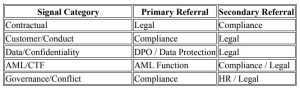

This referral mapping is illustrative only. Applicable referral pathways will vary by institution, jurisdiction, and regulatory context. Appendix B: Escalation Threshold Framework Disclaimer: The following material provides a conceptual illustration of the escalation threshold dimension of the LCF. It is not a regulatory requirement, a compliance checklist, or an operational protocol. It must be adapted to the institution’s specific governance framework, applicable law, and regulatory context before any operational use. It must not be used as a performance evaluation or monitoring instrument. Conditions that plausibly warrant mandatory referral to the relevant specialist function: • A transaction or operational pattern that may constitute or facilitate a breach of applicable law or regulation • A customer complaint that may result in formal legal proceedings or regulatory notification obligations • Regulatory enquiry, inspection, or investigation, whether formal or informal • An incident involving potential unauthorised access to or loss of personal data • A transaction exhibiting AML/CTF risk indicators that exceed the manager’s triage capacity • A proposed deviation from standard contractual terms in a material respect • A new product, service, or distribution arrangement with material legal uncertainty • A situation involving a real or apparent conflict of interest affecting a decision-maker • Pressure, whether direct or indirect, to bypass or override internal control processes Conditions that plausibly warrant optional referral at the manager’s discretion: • Ambiguity about the application of internal policy to a specific operational situation • Documentation questions without immediate transactional significance • Routine repetitive issues that fall within established parameters but present minor variations • Requests for information about legal or regulatory requirements in the normal course of operations Appendix C: Institutional Preconditions Checklist Disclaimer: The following checklist is a conceptual analytical tool derived from the LCF model. It is offered for academic and analytical purposes only. It does not constitute a regulatory compliance checklist, a governance audit tool, or an operational self-assessment instrument. Its application in any specific institutional context requires expert legal and governance assessment. For legal coaching to function as an effective complementary governance mechanism, the following institutional conditions are analytically identified as necessary: 1. Published escalation thresholds: The institution maintains and communicates to firstline managers clear and accessible guidance on the conditions that require referral to legal, compliance, or other specialist functions. 2. Defined reporting lines: First-line managers have access to clear guidance on the referral pathways available to them, including contact points and escalation protocols for each relevant specialist function. 3. Formal ownership: Legal and/or compliance functions have formal, documented responsibility for receiving, assessing, and responding to legal risk referrals from the first line. 4. Documentation protocols: The institution maintains protocols for the documentation of legal risk referrals and coaching interactions that are consistent with applicable LPP doctrine and GDPR requirements. 5. Confidentiality frameworks: Coaching interactions are governed by explicit confidentiality agreements that specify the limits of confidentiality, the conditions under which coaching records may be accessed, and the prohibition on use of coaching records for performance evaluation. 6. Coach qualification standards: The institution has defined the qualification and experience standards applicable to persons delivering legal coaching, including minimum legal knowledge requirements and professional boundaries training. 7. Programme review mechanisms: The legal coaching programme is subject to periodic review against defined programme objectives, with review outcomes reported to the governance function responsible for internal governance adequacy. References Legal and Regulatory Materials Basel Committee on Banking Supervision. Corporate Governance Principles for Banks. Bank for International Settlements, July 2015. Directive 2013/36/EU of the European Parliament and of the Council of 26 June 2013 on access to the activity of credit institutions and the prudential supervision of credit institutions and investment firms, OJ L 176, 27 June 2013. Directive (EU) 2019/878 of the European Parliament and of the Council of 20 May 2019 amending Directive 2013/36/EU as regards exempted entities, financial holding companies, mixed financial holding companies, remuneration, supervisory measures and powers and capital conservation measures, OJ L 150, 7 June 2019. Directive 2014/65/EU of the European Parliament and of the Council of 15 May 2014 on markets in financial instruments, OJ L 173, 12 June 2014. Directive (EU) 2019/1937 of the European Parliament and of the Council of 23 October 2019 on the protection of persons who report breaches of Union law, OJ L 305, 26 November 2019. European Banking Authority. Guidelines on Internal Governance under Directive 2013/36/EU. EBA/GL/2021/05, 2 July 2021. European Banking Authority. Final Report on Guidelines on Internal Governance under Directive 2013/36/EU. EBA/GL/2021/05, 2 July 2021. European Central Bank. Guide to Fit and Proper Assessments. Revised version, December 2021. European Central Bank. Guide on Climate-Related and Environmental Risks: Supervisory Expectations Relating to Risk Management and Disclosure. November 2020. Regulation (EU) 2016/679 of the European Parliament and of the Council of 27 April 2016, General Data Protection Regulation, OJ L 119, 4 May 2016. Regulation (EU) 2024/1624 of the European Parliament and of the Council of 31 May 2024 on the prevention of the use of the financial system for the purposes of money laundering or terrorist financing. Directive (EU) 2024/1640 of the European Parliament and of the Council of 31 May 2024 on the mechanisms to be put in place by Member States for the prevention of the use of the financial system for the purposes of money laundering or terrorist financing. Regulation (EU) 2024/1620 of the European Parliament and of the Council of 31 May 2024 establishing the Authority for Anti-Money Laundering and Countering the Financing of Terrorism. Case Law Akzo Nobel Chemicals Ltd and Akcros Chemicals Ltd v European Commission, Case C-550/07 P, EU:C:2010:512. AM&S Europe Ltd v Commission of the European Communities, Case 155/79, EU:C:1982:157. Governance, Risk, and Organisational Literature Edmondson, Amy C. “Psychological Safety and Learning Behavior in Work Teams.” Administrative Science Quarterly 44, no. 2 (1999): 350–383. Power, Michael. The Risk Management of Everything: Rethinking the Politics of Uncertainty. London: Demos, 2004. Power, Michael. Organized Uncertainty: Designing a World of Risk Management. Oxford: Oxford University Press, 2007. Reason, James. Managing the Risks of Organizational Accidents. Aldershot: Ashgate, 1997. Schein, Edgar H. Organizational Culture and Leadership. 5th ed. Hoboken: Wiley, 2017. Sitkin, Sim B., and Amy L. Pablo. “Reconceptualizing the Determinants of Risk Behavior.” Academy of Management Review 17, no. 1 (1992): 9–38. Turner, Barry A. Man-Made Disasters. London: Wykeham, 1978. Weick, Karl E. Sensemaking in Organizations. Thousand Oaks: Sage, 1995. Weick, Karl E., and Kathleen M. Sutcliffe. Managing the Unexpected: Sustained Performance in a Complex World. 3rd ed. Hoboken: Wiley, 2015. Legal Risk, Compliance, and Professional Function Literature Bagley, Constance E. “Winning Legally: The Value of Legal Astuteness.” Academy of Management Review 33, no. 2 (2008): 378–390. Bird, Robert C. “Pathways of Legal Strategy.” Stanford Journal of Law, Business & Finance 14, no. 1 (2008): 1–41. DeMott, Deborah A. “The Discrete Roles of General Counsel.” Fordham Law Review 74, no. 3 (2005): 955–981. Hadfield, Gillian K. “The Price of Law: How the Market for Lawyers Distorts the Justice System.” Michigan Law Review 98, no. 4 (2000): 953–1006. Parker, Christine, and Vibeke Lehmann Nielsen. “Corporate Compliance Systems: Could They Make Any Difference?” Administration & Society 41, no. 1 (2009): 3–37. Parker, Christine, and Vibeke Lehmann Nielsen, eds. Explaining Compliance: Business Responses to Regulation. Cheltenham: Edward Elgar, 2011. Siedel, George J., and Helena Haapio. Proactive Law for Managers: A Hidden Source of Competitive Advantage. Farnham: Gower, 2011. Talesh, Shauhin A. “How Dispute Resolution System Design Matters: An Organizational Analysis of Dispute Resolution Structures and Consumer Lemon Laws.” Law & Society Review 46, no. 3 (2012): 463–496. Talesh, Shauhin A. “Legal Intermediaries: How Insurance Companies Construct the Meaning of Compliance with Antidiscrimination Laws.” Law & Policy 37, no. 3 (2015): 209–239.
Seyed Sadeq Qoraishi Corresponding Author Lawyer & Legal Leadership Coach Email: s.qoraishi1159@gmail.com Mahnaz Arefi Monfared Author Certified Transformational Coach, Facilitator and Mentor Email: arefi.mahnaz1977@gmail.com






دیدگاه شما