

Abstract Managerial coaching occupies a structurally contradictory position in contemporary organizations: managers are simultaneously responsible for evaluating and developing the same employees, creating conditions under which developmental authenticity is systematically threatened. Existing theoretical frameworks — including Leader-Member Exchange, empowering leadership, and psychological safety models — address adjacent concerns but do not theorize this dual-role paradox at the level of causal mechanism. This article introduces Coaching Leadership Theory (CLT), a Critical Realist, meso-level theoretical framework that reframes managerial coaching as a structural practice rather than a behavioral skill repertoire. CLT identifies Ethical Role Boundaries (ERB) as the central generative mechanism through which Coaching Mindset becomes capable of enabling genuine developmental dialogue and collaborative performance management, ultimately producing Human Capability Development in Sen’s capability terms. Rather than claiming to resolve the evaluation–development paradox — which would be theoretically indefensible given its structural roots — CLT offers a framework for navigating and partially containing it through explicitly theorized mechanisms, failure modes, and boundary conditions. A distinctive contribution of CLT is the construct of Boundary Performance: the enacted appearance of ethical boundary maintenance without genuine developmental intent. This failure mode is more consequential than outright boundary collapse because it operates through coaching competence, resists detection, and produces retroactive recontextualization of prior disclosures as potentially exploitative. Five theoretically grounded propositions are advanced, each with explicit falsification conditions and boundary specifications consistent with Critical Realist methodology. Keywords: managerial coaching, coaching leadership, ethical role boundaries, evaluation– development paradox, boundary performance, human capability development, Critical Realism, HRD theory 1. Introduction: The Structural Problem of Managerial Coaching 1.1 The Central Contradiction Organizations increasingly require managers to function simultaneously as performance evaluators and developmental coaches (Ellinger & Bostrom, 1999; Hamlin, Ellinger, & Beattie, 2006; McCarthy & Milner, 2013). This expectation is not merely role complexity — it is structural contradiction. Evaluation and development rest on opposed communicative logics: evaluation requires judgment and accountability; development requires safety, vulnerability, and authentic disclosure. When the same person holds both mandates over the same subordinate, the conditions for genuine development are systematically compromised. This contradiction — which we term the Evaluation–Development Paradox — has been acknowledged descriptively in the managerial coaching literature (Ladyshewsky, 2010; Beattie et al., 2014) but has not been theorized at the level of causal mechanism. Existing research has generated substantial empirical evidence for the positive effects of managerial coaching behaviors (Ellinger, Ellinger, & Keller, 2003; Kim, 2014; Heslin, Vandewalle, & Latham, 2006), but this evidence base rests on theoretical foundations that leave the paradox unaddressed. The result is a field that can describe what good coaching looks like but cannot adequately explain why it sometimes fails, how it can be structurally undermined, or under what conditions its effects are contingent. 1.2 Gaps in the Existing Literature Four theoretical gaps motivate this framework: Gap 1: Absence of an integrative causal framework. Despite extensive empirical work on managerial coaching, no integrative theory specifies the generative mechanisms linking managerial dispositions to developmental outcomes through identifiable, potentially falsifiable pathways (see Ladyshewsky, 2010; Kim, 2014 for reviews). Construct-specific studies proliferate without connecting into causal architecture. Gap 2: The dual-role paradox remains theoretically unaddressed. The most distinctive feature of managerial coaching — that the coach holds evaluative authority over the coachee — has not been incorporated into theoretical models as a structural feature requiring explanation. Adjacent frameworks either ignore this feature or implicitly assume it can be bracketed through relationship quality. Gap 3: Coaching conceptualized as skill rather than structural practice. Dominant approaches treat coaching as a behavioral repertoire that can be trained and applied (Ellinger & Bostrom, 1999; Beattie et al., 2014). This framing underestimates the degree to which coaching effectiveness depends on the organizational, relational, and institutional conditions within which it is enacted. Gap 4: Power asymmetry domesticated rather than structurally theorized. The power differential between manager and employee is treated as contextual background rather than as a constitutive feature of the coaching relationship that shapes the conditions for disclosure, trust, and genuine developmental exchange. 1.3 What CLT Claims and Does Not Claim CLT does not claim to resolve the evaluation–development paradox. We treat the paradox as structurally rooted in the simultaneous accountability relationships managers hold — to organizational performance systems and to employee development — and therefore as irreducible by managerial disposition alone. What CLT offers instead is: 1. A specification of the generative mechanisms through which managerial coaching can partially navigate the paradox under identified conditions; 2. A theorization of the structural failure modes — particularly Boundary Performance — through which apparent coaching undermines genuine development; 3. A set of falsifiable propositions that enable empirical engagement rather than assuming the framework’s validity. This is a more modest but more defensible theoretical claim, and one that HRD scholarship is better positioned to engage empirically. 2. Philosophical and Theoretical Foundations 2.1 Critical Realism as Architectural Commitment CLT is grounded in Critical Realism (Bhaskar, 1978; Archer, 1995; Danermark et al., 2002) not as philosophical ornamentation but as a framework that shapes the theory’s architecture in substantive ways. Three Critical Realist commitments structure CLT: Stratified ontology. Social reality operates at distinguishable levels — the real (mechanisms and structures), the actual (events and interactions), and the empirical (observations). CLT’s propositions are formulated as tendency statements about generative mechanisms, not as variance-based linear predictions. A mechanism may be present but inactive, or active but counteracted, depending on the configuration of other conditions. This means ERB may be fully present yet fail to produce developmental dialogue if organizational control systems function as sufficiently powerful countervailing forces. Open systems. Organizations are open systems in which multiple mechanisms operate simultaneously. CLT propositions do not predict outcomes deterministically; they specify the conditions under which mechanisms are activated, blocked, or redirected. Falsification therefore operates at the level of mechanism specification rather than outcome prediction alone. Mechanism–context–outcome logic. Following Pawson and Tilley’s (1997) realist evaluation framework, CLT propositions take the form: in context C, mechanism M generates outcome O. This allows for the possibility that identical managerial behaviors produce different outcomes depending on whether the enabling conditions — particularly ERB integrity and organizational support — are present. This architectural commitment has a direct implication for how CLT’s propositions should be read: they are not linear causal claims in the variance-theory sense. They are claims about what mechanisms, when active and unobstructed, tend to produce. This is why boundary conditions and falsification criteria are specified as integral components of each proposition. 2.2 Communicative and Hermeneutic Foundations Two theoretical traditions provide the normative and process logic underlying CLT’s developmental constructs. Habermas’s theory of communicative action (1984) provides the normative criterion distinguishing genuine developmental dialogue from its counterfeits. Habermas distinguishes communicative action — oriented toward mutual understanding through validity claims — from strategic action — oriented toward achieving predetermined ends. Developmental dialogue, in CLT’s framework, approximates communicative action: it requires openness to revising the manager’s own understanding, genuine attention to employee perspectives, and willingness to follow the logic of the developmental exchange rather than steer it toward evaluative conclusions. Boundary Performance, by contrast, represents strategic action in communicative form — the surface features of developmental dialogue used as instruments of evaluation or control. Gadamer’s hermeneutics (1989) provides the process logic for developmental dialogue as horizon fusion: genuine understanding requires that both participants bring their interpretive frameworks into contact, with the possibility of transformation on both sides. Developmental dialogue that genuinely expands employee capability requires this kind of mutual engagement rather than one-directional information extraction or advice delivery. 2.3 HRD Theoretical Grounding CLT is explicitly positioned within HRD scholarship, not merely borrowing its language. Three HRD traditions directly inform the framework: Workplace learning and informal development (Marsick & Watkins, 1990, 2001): ERB creates conditions for the kind of informal, experience-based learning that HRD scholarship has identified as central to workplace capability development. Without ERB, the everyday interactions through which informal learning occurs become contaminated by evaluative threat. Developmental relationships (Kram, 1985; Ragins & Kram, 2007): CLT extends the developmental relationship literature by specifying the structural conditions — particularly ethical boundary maintenance — that differentiate developmental from control-oriented managerial relationships, and by identifying failure modes that are not captured in mentoring or coaching effectiveness research. Capability expansion (Sen, 1999; Nussbaum, 2011): Human Capability Development as CLT’s primary outcome is grounded in Sen’s capability approach, which defines development not as skill acquisition or performance improvement but as the expansion of real freedom — the substantive abilities people have to live and work as they have reason to value. This positions CLT within HRD’s human flourishing tradition rather than a purely performance-optimization tradition. 3. The Evaluation–Development Paradox: A Structural Account 3.1 Why the Paradox Is Irreducible The evaluation–development paradox arises from a structural feature of managerial roles that no amount of skill, intention, or relationship quality can eliminate: managers hold consequential evaluative authority over the employees they are asked to develop. Performance appraisals, promotion recommendations, assignment decisions, and disciplinary authority remain in the manager’s hands regardless of how the manager frames a coaching conversation. Employees are not naive to this structural reality. Disclosure in a developmental conversation always occurs in the shadow of consequential assessment. An employee who reveals a developmental gap, a performance struggle, or an ambivalence about their role does so knowing that this information exists in the same relational space as the manager’s evaluative function. Rational employees calibrate their disclosures accordingly, creating systematic pressure toward strategic self-presentation rather than authentic developmental engagement. This is not a failure of individual managers or a problem that better coaching training can solve. It is a structural condition that any adequate theory of managerial coaching must address directly. 3.2 Organizational Amplifiers of the Paradox Contemporary organizational systems typically intensify rather than mitigate the paradox through several mechanisms: • Surveillance metrics and performance dashboards that make employee struggles immediately visible and quantifiable • Forced ranking and relative performance systems that create zero-sum competitive dynamics among employees whose development ostensibly serves collective goals • Appraisal contamination, in which information shared in developmental conversations influences formal evaluations even when managers attempt to maintain separation • Career visibility politics, in which managers’ reputations are partly built on appearing developmental while being evaluated on performance extraction These organizational features create conditions under which Boundary Performance — the appearance of developmental practice in service of evaluative or control ends — is structurally incentivized even for managers who begin with genuine developmental intent. 3.3 What CLT Offers: Paradox Navigation, Not Resolution CLT’s contribution to the paradox is not resolution but structured navigation. The framework specifies: (a) the mechanisms through which genuine developmental exchange can occur despite persistent evaluative authority; (b) the conditions under which these mechanisms are activated, sustained, or undermined; and © the failure modes — particularly Boundary Performance — through which the appearance of development masks its absence or subversion. This framing is deliberately more modest than claims of paradox resolution. A theory that claims to resolve a structurally rooted paradox through psychological or behavioral mechanisms alone makes a claim that cannot be sustained theoretically or empirically. A theory that specifies how partial navigation is possible under identifiable conditions is both more honest and more useful. 4. The CLT Framework: Five Constructs and Their Relations 4.1 Overview of the Causal Architecture CLT proposes a five-construct causal architecture organized around two analytical levels: the dispositional level (Coaching Mindset), the structural level (Ethical Role Boundaries), the enactment level (Developmental Dialogue and Collaborative Performance Management), and the outcome level (Human Capability Development and its translation to collective performance). The architecture is not a simple linear chain. ERB functions as a necessary enabling condition for the pathway from Coaching Mindset to developmental outcomes — it is the mechanism through which dispositional orientation becomes enacted developmental practice. This means ERB is not merely one of five parallel constructs; it is the structural hinge on which the framework turns. We address the implications of this for model interpretation in Section 4.3.
Figure 1: CLT Causal Architecture
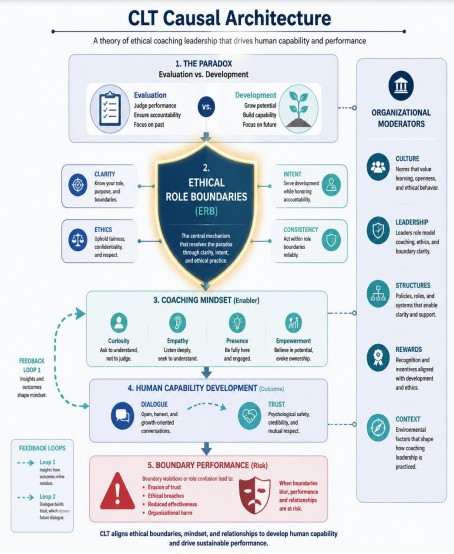
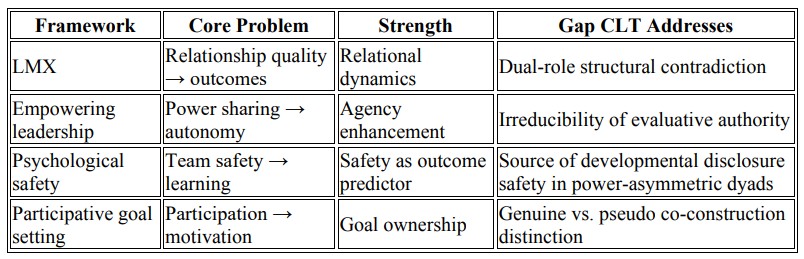
4.2 Coaching Mindset Definition: A relatively stable cognitive-motivational orientation characterized by genuine belief in employee developmental potential, inquiry-based engagement with employee perspectives, and intrinsic valuation of employee growth independent of its performance implications. Distinction from Growth Mindset: Coaching Mindset shares with Dweck’s (2006) growth mindset a belief in malleability, but differs in three theoretically important ways. First, growth mindset concerns the individual’s own capacity; Coaching Mindset is fundamentally otherdirected — it concerns the manager’s orientation toward the developmental potential of a specific other who exists in a power-differentiated relationship. Second, Coaching Mindset requires the capacity to hold the employee’s developmental interests as genuinely distinct from — and potentially in tension with — organizational performance demands and the manager’s own evaluative function. Third, Coaching Mindset includes a structural dimension: not merely believing development is possible but being willing to create and protect the relational conditions that development requires, even when this is costly to the manager. These distinctions are not merely domain differences; they specify a construct with a different motivational structure and different behavioral implications. Coaching Mindset as prerequisite, not sufficient condition: Coaching Mindset is necessary but not sufficient for productive CLT outcomes. A manager with genuine Coaching Mindset who operates in a high-control organizational system, or who lacks the skill and institutional support to establish and maintain ERB, will not reliably produce developmental dialogue or capability development. This conditionality is a feature of the framework, not a weakness — it specifies where interventions must occur. 4.3 Ethical Role Boundaries (ERB(: Definition, Dimensions, and the Question of Construct Scope 4.3.1 Definition ERB is defined as a dyadic relational-structural property of the manager–employee relationship: the degree to which the practical and communicative separation between the manager’s evaluative and developmental roles is enacted, mutually recognized, and institutionally supported within a given manager–employee relationship. Four clarifications of this definition are essential to prevent construct stretching: 1. Level of analysis: ERB is a dyadic, relational-structural property. It exists at the level of the manager–employee dyad, not the individual manager, not the team, not the organization. The same manager may maintain high ERB integrity with one employee and low ERB integrity with another. The same organizational policy environment may enable high ERB in one dyad and be insufficient in another. This level specificity is critical for research design. 2. Relational-structural, not behavioral: ERB is not a behavior the manager performs. It is a property of the dyadic relationship — shaped by manager behavior, employee perception, organizational context, and institutional support — that has structural effects on what kinds of communication are possible within that relationship. Measuring only manager behavior will systematically misspecify ERB. 3. Enacted and mutually recognized: ERB requires not only that the manager maintain boundaries but that the employee perceives those boundaries as genuinely maintained. A manager may scrupulously avoid formal appraisal contamination but fail to achieve ERB if the employee does not perceive the boundaries as credible or stable. 4. Ethically grounded: ERB is designated ethical rather than merely functional because its function is the protection of specific ethical conditions: employee autonomy in developmental engagement, non-exploitation of vulnerability disclosed in developmental contexts, respect for developmental dignity, and fidelity to HRD’s human flourishing mandate. 4.3.2 ERB Dimensions ERB operates across three enactable dimensions: Temporal boundary: The degree to which developmental and evaluative interactions are separated in time, framing, and procedure, such that employees can engage in developmental conversations without experiencing them as continuous with evaluative processes. Discursive boundary: The degree to which the communicative register, purpose, and ground rules of developmental conversations are clearly distinguished from evaluative conversations — including explicit meta-communication about what is shared in a developmental context and how it will (and will not) be used. Psychological safety floor: The minimum level of perceived safety for developmental disclosure that ERB must sustain. This is not a separate construct from psychological safety (Edmondson, 1999) but a specification of the threshold ERB must achieve to enable communicative conditions approximating genuine developmental exchange. 4.3.3 The Primacy of ERB in CLT Architecture Because Developmental Dialogue without ERB integrity degenerates into pseudo-development (see Section 4.4), ERB functions not as one of five parallel constructs but as an enabling condition for the developmental pathway. This has an important implication for how the model should be represented and tested: ERB must be measured and its effects estimated before conclusions are drawn about the pathway from Coaching Mindset to developmental outcomes. Studies that treat ERB as simply one more predictor in a linear model will misspecify CLT’s architecture. This primacy does not reduce CLT to a single-mechanism theory. The other constructs specify what happens given ERB integrity: what Developmental Dialogue looks like at different ERB levels, how Collaborative Performance Management generates psychological ownership under genuine co-construction conditions, and how Human Capability Development aggregates to collective outcomes. These are substantive theoretical claims that extend beyond ERB itself. 4.4 Developmental Dialogue Definition: A communicative practice characterized by genuine inquiry into employee experience, reflective co-exploration of developmental challenges, collaborative meaningmaking, and openness to revising the manager’s own understanding — approximating Habermas’s communicative action and Gadamer’s horizon fusion. Conditions for genuine developmental dialogue: High-quality developmental dialogue requires: (a) ERB integrity sufficient to create perceived disclosure safety; (b) Coaching Mindset in the manager; © employee willingness to engage — itself partly a function of ERB credibility and trust accumulated from prior interactions; and (d) sufficient unstructured time and protected interaction space. Developmental dialogue versus pseudo-development: Under low ERB conditions, what appears as developmental dialogue becomes dialogic pseudo-development — surface-form developmental conversation that functions structurally as information extraction, performance monitoring, or impression management. The distinction is not visible in the behavioral features of the conversation; it is visible in its structural conditions, its communicative orientation (strategic versus communicative), and its downstream effects on trust and capability. 4.5 Collaborative Performance Management Definition: A performance management approach characterized by genuine co-construction of performance goals, shared interpretation of performance challenges, and mutual accountability for developmental support — as distinct from participative consultation in which the manager solicits input before making unilateral decisions. Distinction from pseudo-participation: Pseudo-participation (Argyris, 1998) — soliciting employee input without genuine openness to its influence — produces reactance and cynicism rather than psychological ownership. CLT’s contribution here is specifying the structural conditions under which genuine co-construction is possible: it requires ERB integrity, because goal-setting that occurs in contaminated evaluative-developmental space will be shaped by employees’ strategic self-presentation rather than authentic capability assessment. Organizational constraints: Under high-control systems featuring forced distributions, cascaded fixed targets, or incentive systems that preclude meaningful goal co-construction, Collaborative Performance Management may be structurally impossible regardless of manager intent. This is a boundary condition, not a design failure in CLT. 4.6 Human Capability Development Definition: The expansion of employees’ real substantive capacities — in Sen’s (1999) terms, their real freedoms to exercise abilities they have reason to value in their work and professional lives. Scope: This definition includes skill acquisition but is not reducible to it. Capability development involves expanded agency, enhanced problem-solving in novel contexts, deepened professional identity, and increased capacity to navigate organizational complexity. These dimensions require developmental conditions that performance training approaches cannot supply — specifically, the conditions of authentic disclosure, reflective engagement, and meaning-making that ERB enables. Distinction from performance improvement: Capability development may produce performance improvement as a downstream consequence, but the theoretical outcome of interest in CLT is the expansion of capability itself. This distinction matters because it determines how success should be measured and over what time horizon. 5. Boundary Performance: The Signature Failure Mode 5.1 Definition and Theoretical Importance Boundary Performance is defined as: the enacted appearance of Ethical Role Boundary maintenance without genuine developmental intent — the use of coaching language, structure, and behavioral form as vehicles for evaluation, information extraction, or performance control under developmental framing. Boundary Performance is CLT’s most theoretically distinctive contribution to coaching failure analysis. Two other failure modes — Boundary Collapse (complete absence of separation between evaluative and developmental roles) and Boundary Erosion (gradual degradation of boundary integrity over time) — are recognizable in the existing literature even if not named. Boundary Performance is categorically different. 5.2 Why Boundary Performance Is More Consequential Than Collapse or Erosion Three features distinguish Boundary Performance from the other failure modes: It is enabled by competence. Boundary Performance requires the manager to possess sufficient coaching skill to enact the behavioral surface features of developmental dialogue convincingly. This means it is more likely, not less, where managers have received coaching training, and it is more likely in organizational cultures where developmental rhetoric is institutionally valorized. It is structurally harder to detect. Boundary Collapse and Erosion are visible to employees through observable behavioral signals. Boundary Performance, by definition, lacks these signals. Detection requires either a discrepancy between behavioral signals and downstream outcomes (e.g., information shared in developmental contexts appears in evaluative contexts) or retrospective reinterpretation triggered by a specific revelatory event. Its discovery produces retroactive recontextualization of trust. When employees detect Boundary Performance, they do not merely update their assessment of future disclosure safety. They reinterpret prior developmental interactions as potentially exploitative — re-reading disclosures made under conditions they believed were safe as having potentially served evaluative or control functions. This retroactive contamination is uniquely destructive to developmental relationships and organizational trust in coaching as a practice. 5.3 Theoretical Differentiation from Adjacent Constructs To establish Boundary Performance as a theoretically distinct construct rather than a relabeling, we differentiate it from four adjacent constructs: Impression management (Jones & Pittman, 1982): Impression management concerns the actor managing others’ perceptions of themselves. Boundary Performance is a structural misalignment between enacted role separation and developmental intent — it is a systemic property of a coaching relationship, not an episodic self-presentation tactic. Pseudo-participation (Argyris, 1998): Pseudo-participation involves soliciting input without genuine openness to its influence, typically in decision-making contexts. Boundary Performance involves enacting developmental role structures without genuine developmental intent, specifically in the context of the evaluation–development paradox. Pseudo-participation is a feature of Collaborative Performance Management failure; Boundary Performance is a systemic property of the CLT architecture. Symbolic compliance (Meyer & Rowan, 1977): Symbolic compliance involves organizational adoption of institutional forms without substantive enactment — decoupling at the organizational level. Boundary Performance operates at the dyadic relationship level and involves active enactment of the form, not merely adoption of the label. Performative coaching (general usage): This term is used loosely in practitioner literature to describe surface-level coaching behaviors. Boundary Performance is a theoretically specified construct with defined antecedents (structural incentives for developmental appearance), mechanisms (strategic-action-in-communicative-form), and predictable consequences (retroactive trust contamination). 5.4 Structural Antecedents of Boundary Performance Boundary Performance is not primarily a moral failure of individual managers. It has identifiable structural antecedents: • Organizational incentive systems that reward apparent developmental orientation while evaluating managers on performance extraction • Coaching as institutional rhetoric: organizations that adopt coaching language as a legitimation strategy create conditions where developmental appearance serves managerial career interests regardless of developmental substance • Evaluation systems that create value for information extracted through developmental conversations • Performance management cultures in which coaching conversations become intelligencegathering mechanisms These structural antecedents imply that Boundary Performance will be more prevalent in organizations where developmental language has been most aggressively institutionalized — a counterintuitive implication that CLT generates and empirical work could test. 6. Propositions Each proposition is formulated as a Critical Realist tendency statement specifying mechanism, conditions, and falsification criteria. Proposition 1: ERB integrity mediates the relationship between Coaching Mindset and Developmental Dialogue quality, such that Coaching Mindset predicts high-quality developmental dialogue primarily through its effects on ERB enactment and employee-perceived disclosure safety. Mechanism: Coaching Mindset motivates ERB-sustaining behaviors; ERB enactment shifts employees’ perceived disclosure safety toward communicative rather than strategic orientation; communicative orientation enables high-quality developmental dialogue. Boundary conditions: This mediation is expected to be weaker (a) in high power-distance cultural contexts where structural authority differentials are normatively reinforced, reducing the effectiveness of relational boundary maintenance, and (b) in high-control organizational systems featuring intensive surveillance, ranking, or appraisal contamination mechanisms. Falsification: If ERB does not predict developmental dialogue quality beyond Coaching Mindset under conditions of adequate organizational support, the mediating mechanism is disconfirmed. Proposition 2: ERB integrity violations produce asymmetric negative effects on Human Capability Development pathways — specifically, Boundary Performance produces more severe trust contamination than Boundary Collapse or Boundary Erosion because it generates retroactive recontextualization of prior developmental disclosures. Mechanism: ERB violations signal that developmental conversations were operating under strategic rather than communicative logic; Boundary Performance violations additionally signal that prior disclosures under perceived safety may have been exploited, producing retroactive contamination of accumulated trust. Boundary conditions: The severity of retroactive contamination is expected to be greater (a) the longer the prior developmental relationship (more prior disclosures to reinterpret), (b) the more consequential the information disclosed, and © the more visible the exploitation event. Falsification: If Boundary Performance and Boundary Collapse produce equivalent trust-loss effects, the differential retroactive contamination mechanism is disconfirmed. Proposition 3: Developmental Dialogue quality predicts Human Capability Development only when ERB integrity is sufficient to support genuine reflective processing; under insufficient ERB, high-frequency developmental dialogue degrades into dialogic pseudo-development that may produce negative capability effects through strategic self-concealment. Mechanism: Sufficient ERB → employee communicative orientation → horizon fusion processes (Gadamer) → expanded self-understanding → capability expansion. Insufficient ERB → employee strategic orientation → self-protective performance in dialogue → absence of reflective processing → no capability expansion or regression through confirmed selfconcealment patterns. Boundary conditions: The ERB threshold required for genuine developmental dialogue is higher (a) the greater the organizational performance pressure, (b) the more consequential the evaluative relationship, and © the less institutionally supported the developmental role separation. Falsification: If developmental dialogue predicts capability development regardless of ERB integrity level, the conditionality of the mechanism is disconfirmed. Proposition 4: Collaborative Performance Management predicts Human Capability Development through psychological ownership and intrinsic accountability motivation when genuine co-construction is structurally possible; pseudo-participative performance management produces reactance and developmental cynicism when employees perceive goal-setting as formally consultative but substantively unilateral. Mechanism: Genuine co-construction → psychological ownership of performance goals → intrinsic accountability motivation → active capability investment. Pseudo-participation → perceived manipulation → reactance → withdrawal from developmental engagement → reduced capability development. Boundary conditions: Genuine co-construction requires (a) ERB integrity in the managerial relationship, (b) organizational performance systems that permit meaningful goal variation, and © managerial authority to actually incorporate employee input into goal parameters. Under forced-distribution, cascaded-fixed-target, or high-uniformity systems, genuine co-construction may be structurally foreclosed. Falsification: If pseudo-participative and genuine co-construction performance management produce equivalent capability effects, the authenticity mechanism is disconfirmed. If the predicted reactance effect of detected pseudo-participation does not materialize, the cynicism pathway is disconfirmed. Proposition 5: Individual Human Capability Development translates to team-level performance improvement through emergent collective capability, conditioned on organizational learning culture; this translation is amplified by knowledge-sharing norms, failure tolerance, and reflective practice institutionalization, and blocked by competitive individualism, high knowledge-hoarding incentives, or low failure tolerance. Mechanism: Individual capability expansion → expanded contribution repertoire → knowledge sharing under learning culture conditions → team-level capability emergence → collective performance improvement. Boundary conditions: The individual-to-collective translation requires (a) organizational learning culture above a threshold that supports rather than competes with knowledge sharing, (b) team interdependence sufficient to make shared capability economically valuable, and © absence of strong countervailing competitive incentives. Evaluation implication: Studies that measure only individual-level outcomes will systematically miss this emergence pathway. Studies that measure team-level outcomes without controlling for learning culture will produce inconsistent results. Both patterns are predictable from CLT and serve as indirect tests of the framework. Falsification: If individual capability development translates to team performance regardless of organizational learning culture, the emergent amplification mechanism is disconfirmed. 7. Theoretical Positioning: CLT and Adjacent Frameworks 7.1 Principles of Comparison A fair theoretical comparison must identify the specific theoretical problem each framework was designed to address, acknowledge each framework’s contributions within its domain, and specify the precise gap CLT addresses that adjacent frameworks do not — without attributing failures to frameworks that were not designed to address the problem in question. 7.2 Leader-Member Exchange Theory LMX theory (Graen & Uhl-Bien, 1995) offers a well-developed account of how relationship quality between managers and employees influences a wide range of outcomes including development, performance, and career advancement. It is empirically robust and theoretically sophisticated within its domain. CLT does not claim LMX is inadequate; it claims LMX addresses a different theoretical problem. LMX theorizes relationship quality as a predictor of outcomes; CLT theorizes the structural mechanisms within the manager–employee relationship that specifically enable or undermine developmental authenticity. The dual-role paradox is not a problem LMX was designed to address: it assumes a relationship quality continuum without theorizing the structural contradiction introduced by simultaneous evaluative and developmental authority. Consequently, LMX cannot predict when high-quality LMX relationships will produce Boundary Performance, or why employees in high-LMX relationships sometimes exhibit strategic self-presentation in developmental conversations. 7.3 Empowering Leadership Empowering leadership research (Ahearne, Mathieu, & Rapp, 2005; Zhang & Bartol, 2010) contributes important insights into how managers can enhance employee autonomy, motivation, and self-direction. Its contribution to the developmental practice literature is genuine. CLT diverges from empowering leadership at a specific theoretical point: empowering leadership typically treats power reduction or delegation as the mechanism through which developmental outcomes are achieved. CLT holds that managers cannot reduce their evaluative authority — it is structural, not dispositional. The manager who believes they have suspended evaluative authority in a coaching conversation is mistaken; the employee who perceives this believes something that the organizational structure contradicts. CLT’s mechanisms therefore operate within persistent power asymmetry rather than attempting to diminish it. 7.4 Psychological Safety Psychological safety (Edmondson, 1999) is the most proximate construct to CLT’s concerns and requires the most careful differentiation. Edmondson’s work is foundational and CLT depends on it. CLT’s theoretical claim is not that psychological safety is insufficient, but that it is a consequence — partially produced by ERB — rather than a theorized mechanism. Psychological safety does not specify what creates it in power-differentiated developmental relationships, why it can exist for team-level learning purposes but not for developmental disclosure purposes in the same team, or how its evaluative contamination occurs. ERB addresses these questions by specifying the structural conditions under which developmental disclosure safety is created, maintained, or undermined within a specific power-asymmetric dyad.

Discussion 8.1 What CLT Contributes to HRD Theory CLT’s contributions to HRD theory operate at three levels: Conceptual level: CLT reframes managerial coaching from a skill repertoire to a structural practice — a reframing that shifts the locus of explanation from individual competence to relational and institutional conditions. This has direct implications for how HRD scholars conceptualize the development of developmental capacity in organizations: it is not primarily a training problem but an institutional design problem. Theoretical level: CLT introduces Boundary Performance as a theoretically specified construct that addresses a gap in the HRD failure analysis literature. The existing literature has no construct for the case where developmental practice has been institutionally captured — where coaching rhetoric and behavioral form serve evaluation and control rather than development. This gap matters because Boundary Performance is precisely the failure mode that becomes more prevalent as coaching is more aggressively institutionalized. Methodological level: CLT’s Critical Realist foundations generate specific implications for research design. Studies must: (a) measure ERB at the dyadic level with multi-informant instruments; (b) distinguish ERB integrity from coaching behavior frequency; © test conditionality rather than main effects; (d) include organizational system variables as structural constraints rather than controls; and (e) design for retroactive trust contamination effects that may not be visible in cross-sectional data. 8.2 The Paradox of Coaching Institutionalization CLT generates a theoretically important and practically concerning implication: the more aggressively organizations institutionalize coaching as a managerial mandate, the more they create the structural conditions for Boundary Performance. When coaching is required, evaluated, and rewarded institutionally, managers face incentives to perform coaching regardless of whether genuine developmental conditions are present or genuine developmental intent exists. This creates a self-undermining dynamic in organizational coaching initiatives that CLT is positioned to explain and that existing frameworks are not. This implication does not argue against coaching institutionalization; it argues for attention to the structural conditions — ERB integrity, institutional support for role separation, measurement of developmental outcomes rather than coaching behaviors — that distinguish genuine from performative institutional coaching. 8.3 Power Asymmetry as Irreducible Theoretical Commitment CLT’s insistence on the irreducibility of power asymmetry is a deliberate theoretical commitment with implications for practitioners and researchers. For practitioners, it implies that coaching effectiveness programs that focus exclusively on manager skill development without attending to organizational power systems will be limited in their effectiveness and may inadvertently create conditions for Boundary Performance. For researchers, it implies that coaching effectiveness studies that do not include measures of organizational control systems, appraisal contamination risk, and structural role separation support are systematically misspecified. 9. Limitations and Future Research Directions 9.1 Measurement Development The most pressing research need generated by CLT is the development of an ERB scale with appropriate psychometric properties. Such a scale must: • Capture ERB at the dyadic level, requiring matched manager–employee data • Distinguish manager-enacted ERB behaviors from employee-perceived ERB integrity • Include items sensitive to the three ERB dimensions (temporal, discursive, psychological safety floor) • Include items capable of detecting Boundary Performance discrepancies — cases where manager-reported ERB maintenance diverges from employee-perceived ERB credibility and from downstream outcomes The development of such a scale is both a measurement challenge and a theoretical test: if ERB dimensions do not cohere into a reliable and distinct construct, the theoretical architecture requires revision. 9.2 Boundary Performance Detection Boundary Performance poses specific methodological challenges because its defining feature is that it is difficult to detect. Research designs adequate for studying Boundary Performance will likely require: • Longitudinal designs capable of tracking the retroactive trust contamination effect following detection events • Qualitative and mixed-methods approaches capable of capturing employee sensemaking processes • Discrepancy indicators comparing manager-reported and employee-perceived ERB integrity • Organizational-level data on incentive structures that predict Boundary Performance prevalence 9.3 Cultural Boundary Conditions CLT is developed within a primarily Western organizational context. Power distance (Hofstede, 1980, 2001), face concerns, collectivist versus individualist norms, and cultural schemas around authority and developmental relationships may substantially modify the mechanisms CLT proposes. Specifically, in high power-distance contexts, ERB maintenance may be structurally less feasible because the cultural norm of managerial authority works against the psychological conditions for developmental disclosure safety. Cross-cultural testing of CLT propositions is necessary before the framework can claim general applicability. 9.4 Multilevel Research Design P5’s individual-to-collective translation claim requires multilevel research designs that can test emergent processes rather than simply aggregate individual-level data. This is methodologically demanding and requires samples large enough to support cross-level modeling, measurements at appropriate time points for emergence to be visible, and organizational-level data on learning culture and structural amplifiers. 9.5 Organizational System Effects CLT treats organizational control systems, incentive structures, and evaluation designs as structural antecedents of ERB integrity and Boundary Performance. Future empirical work should measure these as substantive predictors rather than as background controls, enabling tests of the structural pathway: organizational system design → ERB feasibility → developmental outcome quality. 10. Conclusion This article has introduced Coaching Leadership Theory (CLT) as a Critical Realist, meso-level theoretical framework for understanding managerial coaching as a structural practice embedded in persistent power asymmetry. CLT’s central theoretical contribution is not the claim that coaching works — that is well established empirically — but the specification of why it works under some conditions, why it fails under others, and how its apparent form can be systematically decoupled from its developmental substance. Three theoretical contributions deserve emphasis: ERB as the structural hinge of developmental practice. Ethical Role Boundaries are not simply a moderator or an additional predictor in a coaching effectiveness model. They are the mechanism through which the dual-role paradox is partially navigated — the structural condition that makes genuine developmental dialogue possible in the presence of irreducible evaluative authority. Understanding coaching without theorizing ERB is like theorizing trust without theorizing vulnerability: it leaves out the structural condition that makes the phenomenon possible. Boundary Performance as the signature failure mode of institutional coaching. The most consequential risk in organizational coaching is not incompetent coaching or absent coaching. It is the use of coaching form for non-developmental ends — the deployment of developmental language, structure, and behavioral cues as vehicles for evaluation, control, or organizational legitimation. CLT provides the first theoretically specified account of this failure mode and generates testable predictions about its antecedents, prevalence conditions, and consequences. Paradox navigation rather than paradox resolution. CLT advances a theoretically honest position on the evaluation–development paradox: it cannot be resolved by managerial skill, disposition, or relationship quality alone because its roots are structural. What is possible is partial, conditional navigation through mechanisms that CLT specifies and that empirical research can now test, refine, and challenge. The propositions advanced here are invitations to empirical engagement, not theoretical verdicts. CLT’s value will be determined by the degree to which it generates testable, falsifiable claims, motivates rigorous multilevel and longitudinal research designs, and ultimately advances HRD scholarship’s capacity to understand when and how organizational relationships genuinely expand human capability. References Ahearne, M., Mathieu, J., & Rapp, A. (2005). To empower or not to empower your sales force? An empirical examination of the influence of leadership empowerment behavior on customer satisfaction and performance. Journal of Applied Psychology, 90(5), 945–955. Archer, M. S. (1995). Realist social theory: The morphogenetic approach. Cambridge University Press. Argyris, C. (1998). Empowerment: The emperor’s new clothes. Harvard Business Review, 76(3), 98–105. Beattie, R. S., Kim, S., Hagen, M. S., Egan, T. M., Ellinger, A. D., & Hamlin, R. G. (2014). Managerial coaching: A review of the empirical literature and development of a model to guide future practice. Advances in Developing Human Resources, 16(2), 184–201. Bhaskar, R. (1978). A realist theory of science. Harvester Press. Danermark, B., Ekström, M., Jakobsen, L., & Karlsson, J. C. (2002). Explaining society: Critical realism in the social sciences. Routledge. Dweck, C. S. (2006). Mindset: The new psychology of success. Random House. Edmondson, A. (1999). Psychological safety and learning behavior in work teams. Administrative Science Quarterly, 44(2), 350–383. Ellinger, A. D., & Bostrom, R. P. (1999). Managerial coaching behaviors in learning organizations. Journal of Management Development, 18(9), 752–771. Ellinger, A. D., Ellinger, A. E., & Keller, S. B. (2003). Supervisory coaching behavior, employee satisfaction, and warehouse employee performance: A dyadic perspective in the distribution industry. Human Resource Development Quarterly, 14(4), 435–458. Gadamer, H. G. (1989). Truth and method (2nd ed.). Sheed & Ward. Graen, G. B., & Uhl-Bien, M. (1995). Relationship-based approach to leadership: Development of Leader-Member Exchange (LMX) theory of leadership over 25 years. The Leadership Quarterly, 6(2), 219–247. Habermas, J. (1984). The theory of communicative action, Vol. 1: Reason and the rationalization of society. Beacon Press. Hamlin, R. G., Ellinger, A. D., & Beattie, R. S. (2006). Coaching at the heart of managerial effectiveness: A cross-cultural study of managerial behaviours. Human Resource Development International, 9(3), 305–325. Heslin, P. A., Vandewalle, D., & Latham, G. P. (2006). Keen to help? Managers’ implicit person theories and their subsequent employee coaching. Personnel Psychology, 59(4), 871–902. Hofstede, G. (1980). Culture’s consequences: International differences in work-related values. Sage. Hofstede, G. (2001). Culture’s consequences: Comparing values, behaviors, institutions, and organizations across nations (2nd ed.). Sage. Jones, E. E., & Pittman, T. S. (1982). Toward a general theory of strategic self-presentation. In J. Suls (Ed.), Psychological perspectives on the self (Vol. 1, pp. 231–262). Erlbaum. Kim, S. (2014). Assessing the influence of managerial coaching on employee outcomes. Human Resource Development Quarterly, 25(1), 59–85. Kram, K. E. (1985). Mentoring at work: Developmental relationships in organizational life. Scott Foresman. Ladyshewsky, R. K. (2010). The manager as coach as a driver of organizational development. Leadership & Organization Development Journal, 31(4), 292–306. Marsick, V. J., & Watkins, K. E. (1990). Informal and incidental learning in the workplace. Routledge. Marsick, V. J., & Watkins, K. E. (2001). Informal and incidental learning. New Directions for Adult and Continuing Education, 2001(89), 25–34. McCarthy, G., & Milner, J. (2013). Managerial coaching: Challenges, opportunities and training. Journal of Management Development, 32(7), 768–779. Meyer, J. W., & Rowan, B. (1977). Institutionalized organizations: Formal structure as myth and ceremony. American Journal of Sociology, 83(2), 340–363. Nussbaum, M. C. (2011). Creating capabilities: The human development approach. Harvard University Press. Pawson, R., & Tilley, N. (1997). Realistic evaluation. Sage. Ragins, B. R., & Kram, K. E. (Eds.). (2007). The handbook of mentoring at work: Theory, research, and practice. Sage. Sen, A. (1999). Development as freedom. Oxford University Press. Zhang, X., & Bartol, K. M. (2010). Linking empowering leadership and employee creativity: The influence of psychological empowerment, intrinsic motivation, and creative process engagement. Academy of Management Journal, 53(1), 107–128.
Authors: 1. Seyed Sadeq Qoraishi (Corresponding Author) Lawyer & Legal Leadership Coach s.qoraishi1159@gmail.com 2. Mahnaz Arefi Monfared )Author( arefi.mahnaz1977@gmail.com Certified Transformational Coach, Facilitator and Mentor 3. Nazanin Narges Zhaleh Nazanin.728.n@gmail.com Islamic Azad University, Central Tehran Branch 3. Seyed Amirhossin Qoraishi Independent Researcher amirhossinqoraishi@gmail.com 4. Fatemeh S. Qoraishi Independent Researcher Fatemeh.S.Qoraishi@gmail.com





دیدگاه شما